How Much Does Buddy AI Cost? Pricing, Plans and Sales Commissions Explained
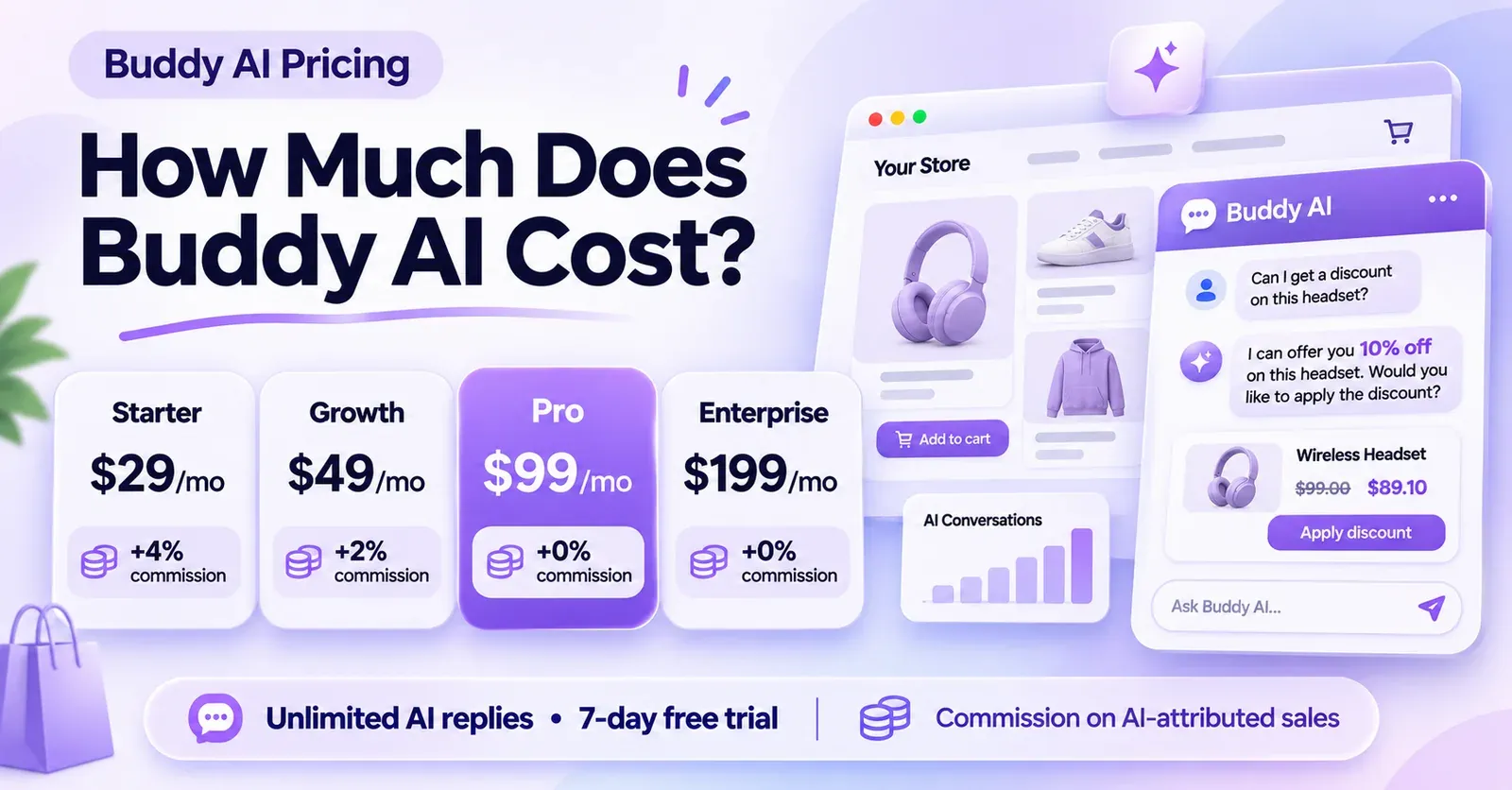
Buddy AI pricing starts at $29 per month, but that is not necessarily what a Shopify merchant will pay in total. The Starter plan combines a $29 monthly subscription with a 4% commission on Buddy AI-attributed sales. Growth costs $49 per month plus a 2% commission, while Pro costs $99 per month with no sales commission. Enterprise is $199 per month with no commission and additional advisory services.
That makes Buddy AI different from AI chat tools that charge by message, conversation, ticket, or automated resolution. Its published plans offer unlimited AI replies, but two of the four plans add a variable cost linked to sales attributed to the AI. A shop with significant attributed revenue can therefore spend much more than the advertised starting subscription.
This guide breaks down all four plans, the commission model, illustrative monthly bills, break-even points, AI Insights limits, the seven-day trial, and the conditions merchants should clarify before installing the app. Prices below are in US dollars, based on the publicly listed Buddy AI plans reviewed in November 2026. Calculations are illustrations, not binding quotes.
Buddy AI pricing at a glance
| Plan | Monthly subscription | Commission on AI-attributed sales | Monthly AI Insights |
|---|---|---|---|
| Starter | $29 | 4% | 25 |
| Growth | $49 | 2% | 100 |
| Pro | $99 | 0% | 500 |
| Enterprise | $199 | 0% | 2,500 |
All four plans advertise unlimited AI replies, unlimited store visitors, unlimited products and collections, and unlimited store pages and blogs. The listed trial is seven days for eligible new subscriptions. The monthly AI Insights figures describe conversation analyses, not a cap on chatbot responses or customer conversations.
The distinction between base subscription and total monthly cost is critical. Starter is the least expensive if attributed sales are relatively low. Growth reduces the commission rate, while Pro removes that commission entirely. Enterprise adds regular audits and a monthly strategy call; its higher price does not automatically make it the least expensive option for most stores.
What is Buddy AI?
Buddy AI: Agentic Commerce is a Shopify app from Buddify. It brings together AI-driven sales assistance, customer-support responses, conversion interactions, and conversation insights. Rather than simply showing a static FAQ, it can use information from a connected Shopify catalog, store pages, policies, and other enabled knowledge to answer shoppers' questions.
The current Shopify listing describes four specialized roles: a Sales Agent that recommends and upsells products, a Support Agent that answers questions and supports human handoff, a Conversion Agent designed to address buying objections and present eligible offers, and an Insights Agent that analyzes conversations. The vendor also advertises lead capture and voice-shopping functionality.
These are product capabilities, not promises that every store will generate a particular amount of revenue. AI answers depend on the accuracy of the catalog and policies, and sales results depend on traffic quality, pricing, merchandising, and many other factors. A merchant should evaluate the product as part of a complete shopping experience instead of assuming that installing a chatbot guarantees conversion growth.
How much is Buddy AI Starter?
Starter costs $29 per month plus 4% commission
Starter has the lowest fixed subscription: $29 per month. It also includes a 4% commission on sales attributed to Buddy AI. The current Shopify listing identifies one included sales strategy, plus the core sales, support, conversion, and insights agents, training on store content, lead capture, and basic chat analytics.
Buddify's separate plan-comparison table lists all four sales strategies as included in every plan, which conflicts with the Shopify App Store's description of Starter. Therefore, a merchant who needs a specific strategy should verify its availability in the installation or billing flow instead of treating either description as a guaranteed entitlement.
Starter includes 25 AI Insights conversation analyses each month. That limit is not a limit of 25 chat sessions. It also does not mean every conversation automatically generates an Insight. The public plan description does not establish a standardized price for purchasing additional Insights if that allowance is exceeded.
Starter can be sensible for testing AI selling on a store with few attributed sales. Its variable commission, however, increases as attributed revenue grows. A $29 subscription is not the complete cost for a store producing a meaningful volume of qualifying transactions.
How much is Buddy AI Growth?
Growth costs $49 per month plus 2% commission
Growth costs $49 per month and cuts the sales commission from 4% to 2%. It includes 100 AI Insights analyses monthly and the same publicly advertised unlimited AI replies. On Shopify's current listing, Growth includes four sales strategies and advanced chat and performance analytics.
The additional $20 fixed fee compared with Starter is offset by a reduction of two percentage points in the commission rate. This makes Growth less expensive in the simplified pricing model once monthly AI-attributed sales exceed $1,000. At exactly $1,000, the two plans have the same modeled cost of $69.
Growth may also be preferable before reaching that break-even point if the extra sales strategies or Insights capacity are useful. Pricing is only one part of plan selection. A store with a product catalog requiring more analysis might choose Growth for functionality even when Starter remains slightly cheaper on commission-adjusted subscription cost.
 Quentin Olaya
How much is Buddy AI Pro?
Pro costs $99 per month with 0% commission
Pro is the first plan with no commission on Buddy AI-attributed sales. Its fixed price is $99 per month, and it includes 500 AI Insights conversation analyses per month. Buddify's pricing table also lists a one-time on-site audit after six weeks.
For merchants whose attributed sales grow, the $99 fixed cost can become more predictable than a lower base subscription paired with a revenue-share percentage. Under the published rates, Pro equals Growth at $2,500 of monthly AI-attributed sales. Above that point, Pro is less expensive in the simplified subscription-plus-commission comparison.
This does not mean Pro delivers zero total operating costs. The Shopify store still has its own subscription, and the merchant may incur staff, marketing, product-discount, or other expenses. It means Buddy AI's published Pro commission rate is 0%, rather than a promise that all costs connected with ecommerce disappear.
How much is Buddy AI Enterprise?
Enterprise costs $199 per month with 0% commission
Enterprise has a published fixed subscription price of $199 per month with 0% commission on attributed sales. It includes 2,500 AI Insights conversation analyses each month. Buddify also advertises an on-site audit every six weeks and a monthly strategy call.
Despite the name, this is an advertised $199 plan rather than an unspecified enterprise-only custom quote. Its positioning is about additional insight capacity and hands-on guidance. A business should still confirm what an audit covers, when the service takes place, and whether any special operational requirements apply to its store.
If a merchant needs only unlimited AI replies and no sales commission, Pro has the lower published base fee. Enterprise makes sense to evaluate when the additional Insights allowance and recurring strategic support have identifiable business value.
How Buddy AI sales commissions work
AI-attributed sales are the commission basis
Starter and Growth describe commissions on Buddy AI-attributed sales, not automatically on every Shopify order. The publicly listed rates are 4% on Starter and 2% on Growth. Pro and Enterprise show 0%.
Buddify explains attributed sales as purchases associated with an interaction with Buddy. This is an attribution measure, not proof that the sale would never have happened without AI. A customer may already have intended to buy before speaking to the assistant. Consequently, merchants should distinguish attributed revenue from incremental revenue caused by AI when evaluating return on investment.
The company's support documentation gives a useful example. A shopper might negotiate a discount through Buddy AI and then have a different, better discount code applied by Shopify at checkout. Buddy AI may still count that completed order as influenced by the AI interaction. The final discount code is therefore not necessarily sufficient to decide whether a sale was attributed to Buddy AI.
What is not publicly specified about commission calculations?
The pricing and support material reviewed does not establish a complete formula covering every billing edge case. Important questions include the attribution window, whether the commissionable amount includes tax or shipping, whether it is calculated before or after discounts, and how refunds, cancellations, and partial refunds affect commissions.
There is also no sufficiently documented general rule for recurring subscription purchases or disputed attribution. Merchants should request these definitions in writing or consult the exact billing terms presented inside Shopify before assuming a particular net-revenue basis. Neither the rate nor the word attributed answers every accounting question.
Monthly cost formula
For simple comparisons, assume the reported attributed-sales value is the same value used to calculate the commission. Under that assumption:
Starter total = $29 + (attributed sales × 4%)
Growth total = $49 + (attributed sales × 2%)
Pro total = $99
Enterprise total = $199
These formulas exclude taxes, any other charges, and differences in features. They are planning models—not a guarantee that an actual Buddy AI invoice will apply a particular taxable or refundable revenue basis.
Buddy AI pricing examples at different sales volumes
The table below illustrates what the four plans would cost at different levels of monthly commissionable AI-attributed sales.
| Monthly AI-attributed sales | Starter ($29 + 4%) | Growth ($49 + 2%) | Pro | Enterprise |
|---|---|---|---|---|
| $0 | $29 | $49 | $99 | $199 |
| $500 | $49 | $59 | $99 | $199 |
| $1,000 | $69 | $69 | $99 | $199 |
| $2,500 | $129 | $99 | $99 | $199 |
| $5,000 | $229 | $149 | $99 | $199 |
| $10,000 | $429 | $249 | $99 | $199 |
At $500 of attributed sales, Starter has the lowest modeled cost. At $2,500, Growth and Pro are tied at $99. At $5,000, Pro's fixed monthly fee is $130 below Starter's modeled cost and $50 below Growth's.
These examples must not be interpreted as a prediction of how much revenue Buddy AI will generate. They simply show the pricing consequences if a particular amount of revenue qualifies for the vendor's commission calculation. A store with $50,000 of total sales might have only a small portion attributed to Buddy AI—or a much larger portion. Overall store revenue alone does not determine the commission.
When is it cheaper to upgrade Buddy AI?
Starter versus Growth: $1,000 break-even point
Set the two cost formulas equal:
$29 + 0.04 × attributed sales = $49 + 0.02 × attributed sales.
That yields $1,000 of attributed sales per month. Below this level, Starter is cheaper if only subscription and commission costs matter. Above it, Growth is cheaper. At exactly $1,000, both modeled bills equal $69.
Growth versus Pro: $2,500 break-even point
Equating Growth's $49 plus 2% commission with Pro's $99 fee gives $2,500 of attributed sales monthly. Growth is cheaper below that point; Pro is cheaper above it. At the threshold, both are $99.
What about Starter versus Pro?
Starter and Pro are equal at $1,750 of attributed sales because $29 plus 4% of $1,750 equals $99. But this direct comparison omits Growth, which is cheaper than either at that revenue level. For cost-only selection across the three plans, the progression is generally Starter below $1,000, Growth between $1,000 and $2,500, and Pro above $2,500.
Enterprise is not the cost-minimizing plan under these simplified scenarios because Pro offers the same advertised 0% sales commission for $100 less per month. Enterprise's case rests on its larger Insights allowance and guidance services.
 Quentin Olaya

Are Buddy AI replies really unlimited?
The current pricing comparison explicitly lists unlimited AI replies on Starter, Growth, Pro, and Enterprise. It also lists unlimited visitors, products and collections, and store pages and blogs. This differs from services that sell a monthly number of AI responses or charge per automated support resolution.
Unlimited replies should not be conflated with unlimited everything. Buddy AI's plans have specific AI Insights allocations, different advisory benefits, and commercial commission rules. The public pricing material also does not justify a claim that every future feature, external integration, or custom service is included without restriction.
For a store with many routine inquiries, the lack of a published per-reply price may make budgeting easier. Yet the commission structure can still make sales performance—not conversational volume—the biggest variable in the total subscription bill.
What are AI Insights, and do the limits matter?
AI Insights are presented as analyses of customer conversations. The listed allowances are 25 for Starter, 100 for Growth, 500 for Pro, and 2,500 for Enterprise per month. They are separate from the general conversation-analytics features advertised on every plan.
For a merchant, such analysis may be useful for identifying recurring objections, product questions, gaps in store information, or reasons shoppers hesitate. But an Insights allowance is not a guaranteed number of generated sales, nor a ceiling on the number of times shoppers can message the AI.
The public pricing table does not specify a standard price for excess AI Insights or a universal rule explaining whether additional analyses can be purchased. Do not assume that unused analyses roll over or that an overage is automatically charged. The exact behavior should be checked in the account or with Buddify.
What features do all Buddy AI plans include?
AI Sales Agent and product recommendations
Buddy AI's Sales Agent is positioned as a product-discovery and upselling assistant. It can use available product information to guide shoppers and suggest relevant items. A recommendation can help a buyer compare alternatives, but the merchant remains responsible for accurate prices, availability, descriptions, and suitability claims.
AI Support Agent and human handoff
The Support Agent answers questions about products and store policies and can help hand conversations to people through supported channels. The Shopify listing discusses handoff via WhatsApp and Instagram. This should not be interpreted as a guarantee that Buddy AI provides every feature of a dedicated omnichannel helpdesk or independently handles every operational request.
In fact, Buddify's help center states that Buddy AI cannot independently issue refunds, modify orders, or override store policies. Answering a customer's question about returns is different from authorizing and processing a refund.
AI Conversion Agent and discounts
The Conversion Agent works on product pages and can respond to customer questions, buying hesitation, and exit intent. The merchant can establish maximum discount limits, choose a sales strategy, and adapt the timing or appearance of prompts. According to Buddify's help center, the four named strategy types are Revenue Accelerator, Margin Guard, Advisory Mode, and Lead Collection.
Discount controls deserve attention because offering a coupon can reduce the margin on an order even when it helps a sale happen. The app subscription, the commission, and the commercial impact of a discount are three different economic considerations.
AI Insights Agent and reporting
The Insights Agent is marketed as a way to turn shopper conversations into opportunities to improve products and merchandising. The number of Insights analyses varies by plan, while conversation analytics are broadly listed. Reporting should inform decisions, not be treated as proof that AI caused every attributed conversion.
Discounts can cost more than the software commission
Suppose a store normally sells an item for $100. If Buddy AI offers a permitted 10% discount, the customer pays $90 for the item before any separate taxes or shipping. The store has surrendered $10 of headline selling price, regardless of which Buddy AI subscription it uses.
If the resulting order is counted as attributed, Starter or Growth may also charge its percentage commission. The exact dollar commission cannot be established from this example without knowing whether the commission applies before or after the discount and what else is included in the vendor's commissionable revenue amount.
A merchant evaluating profitability should therefore look beyond revenue attributed to AI. Useful measures include gross margin after discounts, commissions actually invoiced, order returns, incremental conversion evidence, and the time saved on support. Otherwise, a tool can appear successful on attributed sales while contributing less profit than expected.
Buddy AI describes product, collection, and store discount rules, with more specific limits able to take precedence. Configure and review them carefully, especially for products with thin margins or promotions that might overlap with discount codes already used elsewhere in the store.
Is there a Buddy AI free plan or free trial?
The current Shopify App Store listing displays paid plans rather than a permanent free tier. It advertises a seven-day free trial for each of the four plans, and Buddify's pricing page says the trial is for eligible new subscriptions.
A trial is not the same as a $0 ongoing plan. After a qualifying trial, the selected paid plan may begin billing according to the terms accepted during installation. Merchants should inspect the subscription approval screen and cancellation conditions instead of assuming the trial can continue indefinitely.
Some older indexed listings showed different trial lengths, prices, and commission rates. Those historical snippets should not override the newer four-plan listing. A buyer with an existing account might also have legacy terms, which are not established by the public current pricing table.
Does Buddy AI offer annual billing discounts?
The current Buddy AI pricing table presents monthly rates: $29, $49, $99, and $199. It does not establish a public annual Buddy AI price or an annual discount percentage. Therefore, it would be inaccurate to multiply a hypothetical discounted monthly rate by twelve and advertise it as an official yearly offer.
Buddify also sells a different product called Collective Commerce or Brand Partnerships, for which separate annual billing options may be shown. Those are not Buddy AI plans. Merchants must keep the two products' billing terms separate when reviewing the wider Buddify website.
If a merchant wants a longer commitment or a custom commercial arrangement, the appropriate course is to ask the vendor. No annual Buddy AI savings should be assumed without a specific written quote.
 Quentin Olaya
Cancellation, refunds, and other billing conditions
Buddify's terms describe recurring subscriptions and cancellation that generally takes effect at the end of the current paid period. They also indicate that purchases are generally non-refundable, subject to applicable legal requirements. These provisions should not be recast as a universal money-back guarantee.
Before subscribing, confirm when the trial ends, the applicable Shopify billing cycle, what constitutes a commissionable sale, and how commissions are handled if an order is canceled or refunded. For commission-bearing plans, the attribution rules can matter as much as the base price.
Taxes and the separate Shopify subscription may also affect the overall amount a merchant pays to run the store. They are not automatically Buddy AI-specific add-ons. The public pricing information does not establish a separate mandatory setup fee, per-reply charge, or standard AI Insights overage tariff.
Is Buddy AI worth the price?
For a low-volume Shopify merchant, Starter offers a small fixed commitment and unlimited advertised AI replies, but the 4% attributed-sales commission must be included in any cost calculation. Growth becomes more attractive as qualifying sales approach and exceed $1,000 monthly. Pro offers a fixed $99 subscription without sales commission and can be economically preferable above $2,500 of modeled attributed sales.
The subscription comparison is only the beginning of the decision. A store that needs advanced sales strategies, more Insights analyses, or regular guidance may have reasons to choose a higher plan. A business that already uses a chat widget should test placement and customer experience to avoid overlapping or confusing storefront interfaces.
Performance should be evaluated against sensible measures: customer questions handled accurately, human escalations, quality of product recommendations, discount-driven margin changes, and sales that appear genuinely incremental. Attributed revenue by itself cannot answer all of those questions.
Frequently asked questions about Buddy AI pricing
How much does Buddy AI cost per month?
Buddy AI costs $29/month for Starter, $49/month for Growth, $99/month for Pro, and $199/month for Enterprise. Starter and Growth also carry 4% and 2% commissions, respectively, on AI-attributed sales.
Does Buddy AI charge per message or AI reply?
The current four plans advertise unlimited AI replies, with no separate standard per-reply price listed. Starter and Growth use a sales-attribution commission model instead.
What does the 4% Buddy AI commission apply to?
The published plan says the 4% rate applies to Buddy AI-attributed sales. It does not say 4% of every Shopify order. The exact commissionable revenue basis, attribution window, and adjustment rules need to be checked in the merchant's billing terms.
What is the difference between Starter and Growth?
Starter is $29 plus 4% on attributed sales and includes 25 monthly AI Insights. Growth is $49 plus 2% and includes 100 Insights. The Shopify listing also distinguishes the number of included sales strategies.
When does Pro become cheaper than Growth?
Under the published subscription-and-commission formula, the plans tie at $2,500 in monthly AI-attributed sales. Beyond that, Pro's $99 fee is cheaper than Growth's $49 plus 2%, provided the comparison excludes other costs and feature differences.
Does Buddy AI have a free trial?
Yes. The currently listed trial is seven days for eligible new subscriptions. The public listing does not show a permanent free Buddy AI tier.
Are Buddy AI sales commissions charged on refunds?
The publicly reviewed material does not provide a complete, unambiguous rule for refunded or partially refunded attributed orders. Merchants should confirm the adjustment policy before assuming those commissions always disappear.
Are Buddy AI conversations unlimited?
Buddy AI advertises unlimited AI replies across the four plans. Monthly AI Insights analyses are still limited to 25, 100, 500, or 2,500 depending on the subscription.
Can Buddy AI automatically issue refunds or change orders?
No. Buddify's help center says Buddy AI cannot independently process refunds, change orders, or override store policies. It can provide support information and assist with handoff instead.
Is Buddy AI Enterprise a custom-price plan?
The public pricing page lists Enterprise at $199/month, with no sales commission, 2,500 monthly AI Insights, recurring audits, and a monthly strategy call. Its publicly advertised price should not be confused with an unspecified custom quote.