How Much Does VanChat Cost? Pricing, Plans and AI Reply Fees Explained
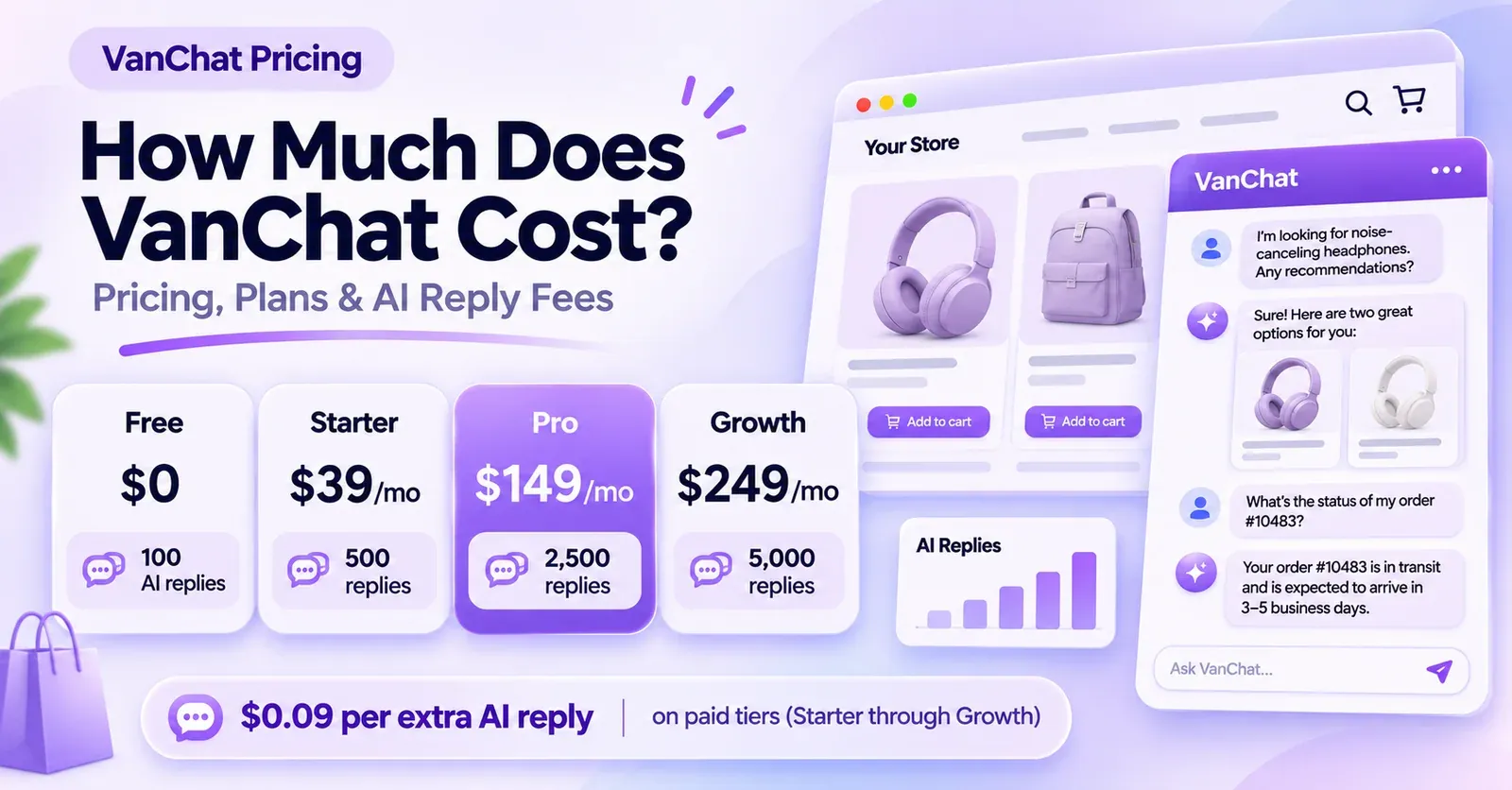
VanChat has a free Shopify plan with 100 AI replies per month, while its paid subscriptions start at $39 per month for Starter. Pro costs $149 per month, Growth costs $249, Scale costs $499, and Business costs $799. Enterprise pricing is customized. For Starter through Scale, VanChat also publishes a charge of $0.09 for each additional AI reply beyond the plan's monthly allowance.
But the subscription price is only one part of the decision. Each VanChat tier also limits the number of products the AI can learn. A merchant with a large catalog may need a more expensive tier even with relatively few customer messages, while a small catalog with busy customer conversations can reach its AI reply limit first. The best plan therefore depends on both chatbot usage and catalog size.
This guide explains VanChat's current plans, annual rates, overage fees, Shopify features, free trials, and the limitations behind its advertised return-on-investment guarantee. The published figures below are in US dollars, based on official information reviewed in November 2026. Where an offer, refund condition, or usage rule is not clearly documented, it is identified as such rather than treated as a guaranteed benefit.
VanChat pricing at a glance
| Plan | Standard monthly price | AI replies per month | Products the AI can learn | Published extra-reply price |
|---|---|---|---|---|
| Free | $0 | 100 | 100 | Not specified |
| Starter | $39 | 500 | 1,000 | $0.09 per reply |
| Pro | $149 | 2,500 | 2,500 | $0.09 per reply |
| Growth | $249 | 5,000 | 5,000 | $0.09 per reply |
| Scale | $499 | 12,000 | 12,000 | $0.09 per reply |
| Business | $799 | 20,000 | 20,000 | Not publicly specified |
| Enterprise | Custom quote | Custom | Custom | According to agreement |
The free tier is listed on the Shopify App Store. Starter through Business appear on VanChat's official pricing presentation, with Enterprise available by contacting sales. All prices are before any applicable taxes, and an eligible Shopify store has its own platform expenses.
One important detail is easy to miss: unlimited visitors do not mean unlimited AI replies. The app advertises unlimited visitors, but it counts the responses its AI generates. Human replies are a separate feature, and the fact that they are unlimited on listed paid plans does not automatically establish unlimited staff accounts or licenses.
Is VanChat free?
What the Free plan actually offers
VanChat lists a genuine Free plan at $0 in the Shopify App Store. It includes 100 AI replies per month and allows the AI to learn from up to 100 products. The listing also names product recommendations, AI instructions, response correction, order tracking, handoff to a person, lead collection, analytics, and unlimited visitors.
For a small store, those allowances can be enough to explore the experience without committing to a recurring VanChat subscription. They are not enough to conclude that the application provides unlimited AI support at no charge. Just a handful of long conversations can consume a considerable portion of the free reply allowance.
The available public pricing information does not clearly state what happens when a Free account consumes its 100 included replies. It would be misleading to claim that the app definitely pauses, automatically upgrades the merchant, or charges the same $0.09 overage rate as its paid plans. Check the actual billing controls and plan terms presented to your store.
Who should start on Free?
Free is most useful for a merchant testing a modest catalog, assessing the AI's answer quality, or checking whether customers are interested in chatting. It can also help a team identify gaps in product descriptions and store policies before committing to automation.
However, a store with hundreds of products or a high volume of customer questions can outgrow the plan for either of two reasons: product-learning capacity or AI reply volume. Having a low number of visitors does not guarantee low AI usage, and having thousands of visitors does not necessarily mean every visitor will start a conversation.
How much is VanChat Starter?
Starter: $39 per month, 500 AI replies
Starter is VanChat's lowest standard paid plan at $39 per month. It includes 500 AI replies per month and a product-learning allowance of 1,000 products. The Shopify App Store also lists lead synchronization and export, conversation search and filters, unlimited human replies, and unlimited visitors.
Its documented overage rate is $0.09 per additional AI reply. If a store uses 600 AI replies in a month, it has used 100 more than its allowance. Under the published rate, the simplified monthly total would be $48: $39 plus $9 in additional replies, excluding tax and other expenses.
Starter includes core product recommendations, AI-powered product search, proactive selling, live chat, and human handoff. According to the current comparison grid, more advanced AI sales automation and certain social-channel integrations begin with Pro rather than Starter.
Starter is therefore a practical entry-level paid tier for smaller catalogs and predictable usage. It becomes less economical if replies consistently exceed the included amount, and it may be functionally insufficient if the store needs integrations reserved for higher tiers.
How much is VanChat Pro?
Pro: $149 per month, 2,500 AI replies
Pro costs $149 per month, with 2,500 AI replies and support for learning 2,500 products. The published additional-reply charge remains $0.09 each. Its feature set expands on Starter to include AI Sales Automation, Instagram and Facebook integrations, and conversation-history export.
A merchant considering Pro should look at both the additional features and the increased allowance. A store sending 2,000 AI replies per month would pay a calculated $174 on Starter: $39 plus 1,500 extra replies at $0.09. Pro's $149 subscription would cover those replies within its allowance, making Pro cheaper before considering feature differences.
Pro does not automatically include the advantages of every higher tier. The comparison grid places multi-market support, additional integrations such as Gorgias and Klaviyo, priority support, and removal of VanChat branding at Growth or above. Verify the specific functions required for your operation instead of assuming that “Pro” unlocks all capabilities.
How much is VanChat Growth?
Growth: $249 per month, 5,000 AI replies
Growth costs $249 per month and includes 5,000 AI replies and 5,000 learned products. The public overage rate is $0.09 per additional reply. VanChat positions Growth as its popular tier and adds functions such as AI-powered insights, removal of VanChat branding, priority support, and multi-market support.
For businesses running multilingual or regional Shopify experiences, multi-market compatibility can matter independently of reply volume. Multilingual AI responses and a formal multi-market feature are not interchangeable terms; availability for specific markets, languages and workflows should be tested.
Growth can also reduce cost relative to a lower plan with substantial overages. At 4,000 AI replies, a Pro subscription would require an extra 1,500 replies, leading to a simplified total of $284. Growth would remain at its $249 subscription price, provided the store also fits within the plan's product-learning capacity.
The tier is a reasonable candidate for growing stores, but it is not unlimited. A busy promotion or an unusually chat-intensive product category can still push the reply count over 5,000.
 Quentin Olaya
How much is VanChat Scale?
Scale: $499 per month, 12,000 AI replies
Scale is $499 per month, with 12,000 included AI replies and capacity to learn 12,000 products. The published additional-reply rate remains $0.09 each. Its pricing summary also mentions sales performance reports and priority support, alongside the capabilities inherited from Growth.
This tier is relevant for stores with high interaction volume or a large catalog. Both dimensions matter: a merchant with 11,000 products but only 1,000 monthly replies may still need Scale to meet the published learning allowance. Conversely, a 50-product store that generates 10,000 replies could also find Scale more economical than paying overages on Growth.
Consider 9,000 monthly AI replies. Growth would exceed its 5,000-reply allowance by 4,000 replies, producing an indicative $609 charge: $249 plus $360. Scale would cost $499 with the same number of replies inside its allowance. This is a useful cost comparison, not a guarantee that every account's billing cycle or usage will behave identically.
How much is VanChat Business?
Business: $799 per month, 20,000 AI replies
Business is advertised at $799 per month, with 20,000 AI replies and capacity to learn 20,000 products. VanChat presents it as a higher-volume offering and lists dedicated customer success among its benefits.
The published description is more limited in one important respect: it does not clearly display a per-reply overage rate for Business. The $0.09 rate shown for Starter through Scale must not automatically be extended to Business without confirmation. That rate could be the same, but it is not established by the public offer consulted for this guide.
VanChat also presents a 14-day free trial on the Business offer. Elsewhere, a generic plan-comparison heading says plans have a seven-day trial. Because these descriptions differ, a buyer should check the specific trial terms shown for Business during checkout or obtain confirmation directly from VanChat.
When does Business become preferable to Scale?
Using only published monthly base prices and Scale's $0.09 overage rate, Business's $799 fixed price matches Scale's calculated cost at about 15,333 AI replies. At 16,000 replies, Scale would be $859 before taxes, while Business would still be $799 within its included 20,000 replies.
That comparison is meaningful only for usage within Business's allowance and does not establish the price of Business overages. Dedicated support and the larger product-learning limit may also justify Business at lower reply volumes.
Does VanChat offer Enterprise pricing?
Enterprise is listed as custom pricing rather than a standardized monthly public amount. VanChat highlights custom AI reply volumes, custom product coverage, custom reporting, and features inherited from Business. The actual price and commercial terms depend on the proposal.
It would be inaccurate to invent an Enterprise starting price or to assume that a custom quote includes unlimited responses. A larger organization should obtain a written specification covering reply allowances, catalog limits, support commitments, integration requirements, usage overages, and the way billing changes if activity exceeds the contract.
How does VanChat count AI replies?
One conversation can consume several replies
VanChat's main usage unit is an AI reply. This means the AI's outgoing responses, not the total number of visitors, customers, chats, or fully resolved tickets.
Imagine a shopper asking whether a jacket is available in medium. The AI answers once. The shopper then asks whether it ships to Germany, and the AI answers again. Finally, the shopper asks about delivery time and receives another response. That is one customer conversation but three AI replies consumed.
The distinction makes a substantial difference to the bill. Two stores can each have 1,000 customer conversations but consume very different reply counts. A store that answers almost everything in one response may use around 1,000 replies, while a store with detailed, multi-turn consultations could consume several thousand.
AI replies, human replies and resolutions are different
An AI reply is generated by automation. A human reply is a message sent by a member of the merchant's team. An AI resolution is a support outcome, typically describing a question resolved without further assistance; it is not VanChat's publicly advertised unit for these plans.
Similarly, an unlimited visitor allowance does not mean unlimited automated conversations. The chatbot can be displayed to many visitors while only a smaller fraction engage with it, but the AI messages it sends still count against the applicable allowance.
Forecasting a monthly reply requirement
A practical starting formula is:
Estimated AI replies = expected AI conversations × average AI replies per conversation.
If 800 visitors chat with the AI in a month and the conversation average is three outgoing AI messages, expected usage is 2,400 AI replies. Pro could accommodate that example within its 2,500 reply allowance. If the average rises to five messages, usage becomes 4,000 replies and the monthly cost comparison changes.
These averages are illustrative assumptions, not vendor promises. A merchant should monitor real conversations during a trial and use its own data rather than import an average from an unrelated ecommerce business.
What happens when you exceed your VanChat AI reply limit?
The published $0.09 overage charge
VanChat publishes $0.09 per additional AI reply on Starter, Pro, Growth and Scale. The simplified monthly calculation is:
Monthly cost = base subscription + (additional replies × $0.09).
Additional replies are the number sent beyond the plan allowance, if usage exceeds it. For example, 3,000 replies on Pro means 500 additional responses. At $0.09, that is $45 in overages, giving an indicative total of $194.
This formula should not be applied to the Free, Business or Enterprise tiers without first confirming their separate terms. The Free plan's limit behavior is not fully explained in the public information reviewed. Business and Enterprise may have different contractual handling.
Real-world monthly cost examples
| Monthly AI replies | Illustrative plan | Included replies | Extra replies | Estimated monthly total |
|---|---|---|---|---|
| 600 | Starter | 500 | 100 | $48 |
| 2,000 | Pro | 2,500 | 0 | $149 |
| 3,000 | Pro | 2,500 | 500 | $194 |
| 4,000 | Growth | 5,000 | 0 | $249 |
| 9,000 | Scale | 12,000 | 0 | $499 |
| 16,000 | Business | 20,000 | 0 | $799 |
All examples assume the monthly base prices shown in the public offer and exclude taxes, Shopify subscriptions, and other potential services. They also assume the shop fits within the product-learning limit for the illustrated plan.
Should you rely on an automatic spending cap?
Do not assume that all VanChat plans have an automatic cap on overage charges. A public, universally applicable overage spending ceiling has not been established in the materials reviewed. The handling of excess usage can also differ for legacy offers or historical lifetime deals.
A store with volatile demand should inspect the usage dashboard, billing controls and live subscription terms. It is better to budget for a realistic peak than to discover after a campaign that a lower subscription generated a larger overage bill.
 Quentin Olaya
When should you upgrade to a higher VanChat plan?
The published monthly prices and $0.09 extra-reply rate allow some useful break-even calculations.
| Comparison | Approximate monthly reply volume where the higher tier becomes cheaper |
|---|---|
| Starter vs Pro | 1,723 replies |
| Pro vs Growth | 3,612 replies |
| Growth vs Scale | 7,778 replies |
| Scale vs Business | 15,334 replies |
For example, Starter costs $39 and includes 500 replies. At 1,723 replies, its calculated cost is $39 plus 1,223 overage replies at $0.09, or $149.07. Pro is $149 with those responses already included. Pro therefore becomes slightly cheaper at that level.
These are price-only thresholds, calculated from published monthly subscription prices. The analysis ignores differences in features, product limits, taxes, annual discounts and any special commercial terms. It also does not establish a Business overage rate: the Scale-to-Business comparison uses only Scale's published overage rate and Business's included 20,000 replies.
In practice, a merchant might need to upgrade before those thresholds because the catalog is larger than the current plan can learn, or because a feature such as AI sales automation, multi-market support or priority support is required.
VanChat product-learning limits: the second pricing constraint
A feature frequently overlooked in chatbot comparisons is the size of the catalog the AI can learn. VanChat's pricing tiers specify 100, 1,000, 2,500, 5,000, 12,000, or 20,000 products, depending on the plan, with custom coverage on Enterprise.
This is separate from the number of AI responses. A merchant with 6,000 products and 200 AI replies per month may still need Scale to have all 6,000 products within the listed product-learning capacity. A merchant with 60 products and 8,000 AI replies, by contrast, is constrained primarily by response volume.
The public pricing does not establish a standard charge per extra learned product. Do not multiply excess products by the $0.09 reply overage rate: those are different things. Nor should you assume that products exceeding the current limit are automatically incorporated into the knowledge base without a higher plan or an agreed arrangement.
The operational quality of the product data also matters. Product descriptions, sizing details, availability, shipping rules and return policies should be maintained so that AI recommendations are grounded in current store information. A larger training allowance does not by itself guarantee accurate answers.
Monthly versus annual VanChat prices
The Shopify App Store lists annual pricing for Starter, Pro and Growth, advertising an approximate 17% saving over paying each subscription monthly for a year.
| Plan | Twelve monthly payments | Annual subscription | Annual savings | Equivalent per month |
|---|---|---|---|---|
| Starter | $468 | $390 | $78 | $32.50 |
| Pro | $1,788 | $1,490 | $298 | $124.17 |
| Growth | $2,988 | $2,490 | $498 | $207.50 |
These equivalent monthly amounts are derived by dividing the published annual charges by twelve. They do not mean the merchant can pay the discounted figure one month at a time. The annual contract requires a larger upfront commitment, and the merchant should confirm how usage-based charges are billed during that subscription.
VanChat's main pricing presentation advertises “two months free” for annual billing. However, the precise public annual checkout prices for Scale and Business were not independently confirmed in the accessible official pricing surfaces reviewed here. It would be misleading to manufacture yearly totals for those tiers or claim an additional 30% seasonal promotion is still active.
What does a VanChat paid plan include?
AI customer support and order assistance
VanChat presents itself as a Shopify-focused AI shopping assistant that answers product and policy questions, supports order tracking, and provides an option to transfer conversations to employees. Those capabilities can help a merchant handle routine inquiries, but an AI response should not be treated as a guaranteed correct answer in every situation.
Merchants remain responsible for maintaining accurate information and supervising how the assistant handles sensitive requests. The public feature list does not establish that VanChat can autonomously approve every refund, change any order without safeguards, or perform all tasks available to a dedicated helpdesk.
Product recommendations and proactive sales
The platform advertises product search, personalized recommendations and proactive engagement. These features can help visitors explore alternatives or address questions while browsing. Pro adds the separately listed AI Sales Automation feature, so merchants should not treat Starter's general product recommendation capabilities as proof that it includes every advanced sales workflow.
Social channels and integrations
Instagram and Facebook integration are displayed from Pro. Growth adds listed integrations involving Gorgias and Klaviyo as well as multi-market support. Shopify Inbox and live chat appear across the compared paid plans.
The Shopify listing also references WhatsApp compatibility, but it does not establish that full WhatsApp AI automation or every associated external charge is included in every subscription. The availability, setup and billing of a specific channel should be checked before committing to a plan for that use case.
Analytics, branding and support
Analytics appear among the entry-level capabilities. Growth adds AI-powered insights, removal of VanChat branding and priority support. Scale includes sales performance reporting, while Business introduces dedicated customer success.
These feature differences matter in addition to reply volume. A merchant who needs a white-label chat widget or the specified integrations may need Growth even if Starter's reply allowance is sufficient.
Is there a VanChat free trial?
The Shopify App Store lists a seven-day free trial for Starter, Pro and Growth, and VanChat's pricing page also shows seven-day trials for Scale. The Business plan's individual offer displays 14 days, although a generic comparison heading refers to seven days for all plans. Business trial duration should therefore be checked in the actual signup flow.
The permanent Free plan and a limited-duration free trial are not the same offer. The former has an ongoing allowance of 100 AI replies per month, while the latter provides an opportunity to test a paid tier before its normal subscription charge applies, subject to eligibility and billing conditions.
There is insufficient current public information to promise that all trials require no payment method or that no paid charge follows an uncanceled trial. Merchants should read the approval screen and schedule an explicit review before the trial expires.
 Quentin Olaya
Does VanChat guarantee a 10x ROI in 60 days?
VanChat's pricing page advertises an ambitious 10x ROI boost within 60 days with a money-back guarantee. This is a vendor marketing claim, not evidence that every merchant will achieve a tenfold return.
The publicly accessible material reviewed does not comprehensively establish the guarantee's eligibility requirements, exact ROI formula, excluded expenses, minimum usage conditions, claim procedure or whether the reimbursement is full, partial, or subject to additional requirements. VanChat's general terms also caution that AI-generated outcomes cannot always be guaranteed to be error-free or suitable for every purpose.
A merchant considering the offer should request the applicable written guarantee terms before paying. In particular, it is important to establish whether “ROI” refers to AI-attributed sales, incremental gross profit, saved support costs or some other calculation. These produce very different figures.
Attribution is not causation. A customer who chats with the AI and then buys a product might have bought it anyway. Revenue attributed to a conversation should not automatically be treated as revenue created by that conversation. For an informed decision, track actual subscription and overage charges, staff time, customer satisfaction and the incremental value that can reasonably be attributed to the tool.
Other costs and restrictions to consider
The total business cost of VanChat may include its subscription, any published AI reply overages and the separate expenses of running a Shopify store. Taxes, other customer-service apps, staff time and any third-party messaging charges can also be relevant, depending on the merchant's setup.
There is no confirmed universal public tariff for additional learned products, Business overages, or an Enterprise account. Likewise, unlimited human responses should not be interpreted as proof of unlimited employee seats. The absence of a listed charge is not sufficient evidence that a feature is contractually unlimited and permanently free.
Older VanChat articles and historical lifetime-deal pages may show different plans, lower prices, visitor limits or GPT reply quotas. Those historical terms should not be used as the current subscription pricing. Merchants who bought older licenses may have contractual rules that differ from today's public recurring plans.
How to choose the best VanChat plan
Step 1: count the products the AI must understand
Start with catalog size. If you have 3,000 products and need the AI to learn all of them, Free, Starter and Pro do not meet the published product limits. Growth is the first listed tier with a 5,000-product allowance. This may decide the plan before considering chat activity.
Step 2: estimate AI replies, not just sessions
Measure how many visitors actually chat and the average number of AI messages in a conversation. Multiply those two figures to estimate monthly replies, then allow for promotions or seasonal peaks. A forecast based only on website traffic is too imprecise for reply-based billing.
Step 3: model overages and compare upgrades
Calculate the lower tier's subscription plus the $0.09 published overage when applicable. Then compare it with the next tier's fixed price and included allowance. If your projected usage is consistently above a break-even point, a higher plan may reduce spending and provide more predictable capacity.
Step 4: verify the exact functions you need
Check whether your plan includes automation, Instagram or Facebook, multi-market support, branding removal, analytics and priority assistance. A cheaper plan can be poor value if it lacks an essential workflow, even when the reply allowance looks adequate.
Step 5: review trial and guarantee terms before annual billing
Use the trial to check real answers, the accuracy of catalog sync and handoffs, and actual reply consumption. If considering an annual commitment, confirm checkout prices and the refund conditions in writing. Do not make financial decisions solely on a marketing return-on-investment guarantee.
Frequently asked questions about VanChat pricing
How much does VanChat cost per month?
VanChat offers a Free plan, then Starter at $39, Pro at $149, Growth at $249, Scale at $499, and Business at $799 per month. Enterprise uses custom pricing. The paid tiers include different numbers of AI replies and learned products.
Is VanChat free for Shopify?
Yes. The Shopify App Store lists a Free plan with 100 AI replies per month and capacity to learn 100 products. The public listing does not fully specify how usage above the free allowance is handled.
How much does VanChat charge per extra AI reply?
VanChat publishes $0.09 per additional AI reply for Starter, Pro, Growth and Scale. A standard overage rate is not clearly published for Free or Business, and Enterprise terms are custom.
Does VanChat charge per conversation?
Its public paid-plan allowance is based on AI replies, not conversations or resolved support tickets. A conversation with four AI responses can consume four replies. Human messages and AI replies are different measures.
Are VanChat visitors unlimited?
Unlimited visitors are advertised across the public tiers. That does not mean the chatbot sends unlimited AI responses: each plan has a monthly AI reply allowance and a separate product-learning capacity.
What is the difference between Pro and Growth?
Pro is $149 per month for 2,500 AI replies and 2,500 learned products, with AI Sales Automation and certain social integrations. Growth is $249 for 5,000 replies and 5,000 products, plus features such as AI-powered insights, branding removal and priority support.
Is the VanChat annual plan cheaper?
The official Shopify listing shows Starter at $390/year, Pro at $1,490/year and Growth at $2,490/year, approximately 17% less than twelve standard monthly payments. Specific annual totals for Scale and Business were not verified here.
Does VanChat have a seven-day free trial?
Seven-day trials are publicly listed for Starter, Pro, Growth and Scale. Business's dedicated offer advertises 14 days, while a generic comparison statement differs. Confirm the applicable period at signup.
Is the 10x ROI money-back guarantee unconditional?
No unconditional guarantee can be established from the public marketing statement alone. The exact eligibility, ROI calculation and reimbursement conditions must be verified with VanChat before relying on the offer.
Can VanChat learn unlimited products?
No unlimited product-learning allowance is published for the standard tiers. The listed capacities range from 100 on Free to 20,000 on Business. Enterprise offers custom coverage subject to its agreement.
Can I pay for extra learned products instead of upgrading?
No standard public per-product add-on tariff was identified. Since product capacity differs by tier, merchants needing more products should confirm whether an upgrade or customized arrangement is required.