How Much Does Dialog Cost? Pricing, Plans and Visitor Limits Explained
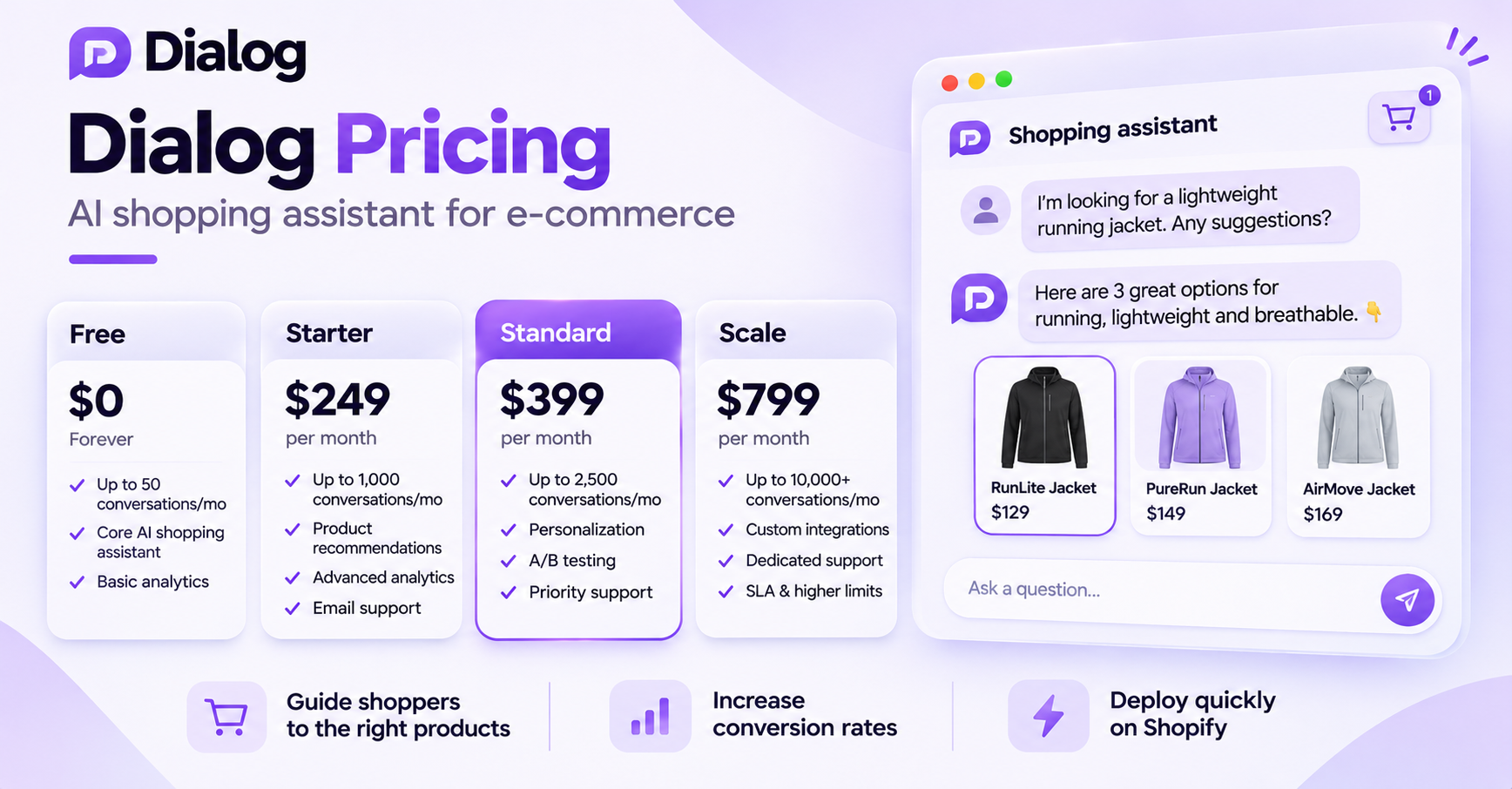
Dialog pricing starts with a Free plan that includes 200 AI conversations per month. Its paid Shopify plans are Starter at $249 per month for up to 25,000 monthly unique visitors, Standard at $399 for up to 50,000, and Scale at $799 for up to 100,000.
All three paid plans advertise a 14-day free trial. Unlike many AI customer-service tools, Dialog's standard paid pricing is tied primarily to store traffic rather than the number of individual AI messages or completed support cases.
That distinction makes Dialog unusual. A business with 50,000 monthly unique visitors might generate 500 shopping-assistant conversations or 5,000, yet the published Standard subscription remains $399 provided its usage and features comply with the plan and applicable terms.
However, this does not mean Dialog has made an unconditional contractual promise of unlimited conversations, and the vendor can review and adjust subscription levels when a store's actual visitor count no longer matches its plan.
This guide breaks down the current Dialog AI prices, what each plan includes, how visitor-based billing works, the separate Free conversation allowance, possible additional costs, and the cancellation and trial conditions. It also explains why Dialog is primarily a pre-purchase AI shopping assistant, not a drop-in replacement for every customer-support platform. All amounts are in US dollars and reflect official information reviewed in November 2026. Taxes and third-party services are excluded unless specified.
Dialog pricing at a glance
| Plan | Monthly price | Published allowance | AI model | Trial |
|---|---|---|---|---|
| Free | $0 | 200 AI conversations per month | Basic | Ongoing free tier |
| Starter | $249 | Up to 25,000 monthly unique visitors | Advanced | 14 days |
| Standard | $399 | Up to 50,000 monthly unique visitors | Advanced | 14 days |
| Scale | $799 | Up to 100,000 monthly unique visitors | Advanced | 14 days |
| Higher-volume or custom arrangement | Not published | Contract-specific | Confirm with Dialog | Confirm with Dialog |
The Shopify App Store and Dialog's own 2026 product comparisons document the three paid prices. Some direct views of the Shopify listing have intermittently omitted the Starter tier even though other official views and Dialog's current published comparisons continue to state the $249 offer. Check the subscription options actually displayed in your Shopify account before approving payment.
The most important pricing detail: Free is expressed in conversations, while the paid tiers are expressed in monthly unique visitors. Those units should never be treated as interchangeable.
What is Dialog AI?
Dialog is an AI-powered shopping assistant for ecommerce websites. Its purpose is to help customers select the right product before they buy. It can answer questions about product details, ask shoppers about their needs, recommend items from the store's catalog and make guidance available directly on product pages or elsewhere in the shopping journey.
The product is positioned closer to an online sales adviser than to a traditional customer-support ticketing platform. A shopper might be choosing between two cosmetics, trying to find a suitable size, comparing compatible accessories or looking for a product that fits a particular budget. Dialog uses the merchant's product information and configured knowledge to support that decision.
The wider Dialog platform also describes a Personal Shopper experience, a product-detail-page assistant, guided discovery, product search, analytics, and reengagement integrations. The exact package purchased matters: the terms allow a customized Personal Shopper service to be subscribed to separately, so not every feature shown in a company demo should automatically be assumed included in the $249 Starter subscription.
Dialog works with Shopify and also discusses integrations with other ecommerce platforms. The most specific public self-service prices reviewed here are those associated with Shopify. Custom enterprise or non-Shopify installations may require different commercial terms.
 Quentin Olaya
Is Dialog free?
Free: $0 for 200 conversations a month
Yes. Dialog has a genuinely free Shopify tier with 200 AI conversations per month. Its published features include a basic AI model, access to the history of conversations and the ability to upload two documents to improve the assistant's answers.
This gives smaller stores a way to test whether conversational product assistance is relevant without immediately committing to a traffic-based subscription. A boutique can connect its products, ask realistic questions and see whether customers use the assistant to resolve doubts before purchasing.
The allowance must be read carefully. It is 200 conversations, not 200 website visitors, 200 AI replies or 200 completed orders. A conversation can involve more than one assistant response. The public Free plan does not supply an exhaustive definition of how a conversation starts or ends, nor does it establish a universal overage charge after the 200th conversation.
What happens when the free allowance is exhausted?
The public price grid does not fully specify whether a free chatbot disappears, pauses answers or offers an account-specific upgrade flow once its 200 conversations have been used. It also does not publish a dollar amount for purchasing one extra conversation on the Free plan. Merchants should check the dashboard or ask the provider about the exact limit behavior rather than assume free overages.
Free's basic model and two-document allowance also differ from the paid packages. For a store with a complex catalog or many policy documents, those knowledge limitations may matter even before the conversation allowance is reached.
Is Free the same as a 14-day trial?
No. Free is a limited ongoing subscription tier. The 14-day trial applies to the advertised paid plans and allows the merchant to evaluate their higher-tier capabilities before paid billing begins. The two offers should be assessed separately, especially because a paid trial can turn into a paid recurring subscription if it is not canceled within the required period.
How much does Dialog Starter cost?
Starter: $249 per month for 25,000 unique visitors
Dialog Starter costs $249 per month and is advertised for stores receiving up to 25,000 monthly unique visitors. It includes the advanced AI model, a custom logo, customizable assistant wording and unlimited uploaded documents for improving AI knowledge, according to the Shopify plan description.
Starter is the entry-level paid traffic tier. It may be appropriate for a growing shop that wants advanced product advice without having its monthly bill rise every time the chatbot produces another response. A store with 10,000 unique visitors and one with 24,000 both fit within the published Starter visitor ceiling, assuming the other terms are satisfied.
That does not make Starter a pay-as-you-go product. A shop using 8,000 visitors does not receive a prorated invoice based on the fraction of the 25,000 allowance used. The standard subscription is $249 per month.
Does Starter include unlimited conversations?
The paid grid is framed around visitors rather than a numeric conversation quota. Dialog's own published example emphasizes that conversation volume does not determine the standard monthly price for a store staying within its chosen traffic tier. However, the plan listing does not establish a universal contractual right to unlimited requests, responses or infrastructure consumption regardless of reasonable-use conditions.
The accurate claim is that Starter is priced by monthly unique visitors, not by a standard per-conversation fee. If conversation volumes are exceptionally high, seek confirmation of applicable usage or fair-use policies instead of interpreting the lack of a conversation number as a promise without limits.
How much does Dialog Standard cost?
Standard: $399 per month for 50,000 unique visitors
Dialog Standard costs $399 per month and supports up to 50,000 monthly unique visitors in the public Shopify grid. Its published feature list mirrors Starter's essential paid capabilities: advanced AI model, custom logo, editable assistant wording and unlimited training documents.
The main published difference is traffic capacity, not a separate quota of AI responses. Moving from Starter to Standard increases the monthly base by $150 and doubles the listed visitor allowance from 25,000 to 50,000.
Suppose a Shopify store attracts 40,000 unique visitors each month. It exceeds Starter's public traffic limit but remains within Standard's. A $399 subscription is the lowest listed paid tier covering that traffic level, assuming its functionality meets the store's needs.
What if shoppers ask thousands of questions?
Dialog's own pricing example uses a store with 50,000 monthly visitors and notes that the Standard base price remains $399 whether the assistant handles 500 conversations or 5,000. That is a useful illustration of traffic-based subscriptions and why engagement alone does not automatically raise the standard price.
It should not be converted into a numerical promise that every Standard account may generate any number of AI conversations under all circumstances. The provider's actual order summary and service conditions remain the controlling references.
How much does Dialog Scale cost?
Scale: $799 per month for 100,000 unique visitors
Dialog Scale costs $799 per month for up to 100,000 monthly unique visitors. It is the highest standard Shopify subscription price publicly documented in the reviewed sources. Like Starter and Standard, it lists the advanced AI model, custom branding options, customizable assistant wording and unlimited uploaded documents.
Scale doubles Standard's traffic allowance but raises the price by $400 per month. It may suit a larger ecommerce brand with enough monthly traffic that the 50,000-visitor tier is insufficient. The number of product questions a store receives remains a separate operational metric, not the published standard pricing unit.
What if traffic exceeds 100,000 unique visitors?
The public Shopify grid does not provide a standard $999 tier, a price per extra 1,000 visitors, or a published self-service plan for 150,000 or 250,000 visitors. It would be inaccurate to invent an overage rate or promise that Scale keeps running indefinitely for $799 regardless of traffic.
A larger store should request a customized quotation or clarification from Dialog. Its terms expressly allow the provider to review actual visitor counts and adjust the subscription where the contracted traffic level does not match usage. That matters far more than guessing a hypothetical per-visitor surcharge.
How does Dialog charge for monthly unique visitors?
Visitors, not messages or support resolutions
Dialog's October 2026 terms state that, absent a different written agreement, subscription prices are determined by the number of monthly unique visitors to the customer's website or application. The company's own pricing comparisons use the same billing unit for paid plans.
These terms are very different from tools billing by AI reply or automated resolution. A visitor can browse without chatting, and another visitor can start a long dialogue about several products. On a paid Dialog tier, the published subscription is based on whether the site's monthly unique visitor count fits the purchased range, rather than automatically multiplying each AI answer by a separate price.
| Metric | Role in Dialog's public pricing |
|---|---|
| Monthly unique visitors | Main unit for paid Starter, Standard and Scale |
| AI conversations | Monthly allowance on Free; engagement metric on paid plans |
| AI replies | No standard per-reply fee published for paid tiers |
| Automated resolutions | No standard per-resolution fee published |
| Product page views | Not the stated billing unit |
| Total browsing sessions | Not the stated billing unit |
| Attributed order value | Not used as the basis of Dialog's subscription billing |
Are Dialog unique visitors the same as Shopify sessions?
Not necessarily. A single person can open more than one session, view several products and return later. Unique visitors, sessions and page views are different measures in analytics, and the reviewed public pricing does not disclose every technical rule Dialog uses to deduplicate a visitor.
It also does not establish that the billing count will always exactly match GA4 active users or a Shopify dashboard metric. Differences can arise from tracking methods, identity rules, browser restrictions and consent mechanisms, even if all tools intend to describe broadly similar audiences.
If your store sits close to a plan boundary, ask which measurement Dialog uses for invoicing, whether its dashboard exposes that count and how disputed discrepancies can be resolved.
What happens if a store exceeds its visitor allowance?
The terms give Dialog a right to audit a customer's use of the service, including the number of monthly unique visitors. The vendor says it will provide 15 days' advance notice before such an audit. It pays for the audit unless a payment discrepancy unfavorable to Dialog is found, and it can adjust the subscription amount according to the updated traffic count.
This is not the same as publishing an automatic overage charge of a few cents per visitor. No such marginal rate is established in the standard price grid. Nor does the documentation prove that the chatbot always shuts off the instant the counter reaches 25,001, 50,001 or 100,001.
The practical approach is to upgrade before your forecast regularly exceeds the purchased band and confirm with Dialog how seasonal peaks are handled. Stores with large sales events should plan around their peak audience rather than only their average quiet month.
Examples of choosing a traffic tier
| Monthly unique visitors | First published paid tier covering the traffic | Base monthly price |
|---|---|---|
| 8,000 | Starter | $249 |
| 25,000 | Starter | $249 |
| 35,000 | Standard | $399 |
| 50,000 | Standard | $399 |
| 70,000 | Scale | $799 |
| 100,000 | Scale | $799 |
| 140,000 | No standard tier confirmed | Custom terms needed |
This table addresses the traffic component alone. A low-traffic merchant may still elect to use Free within its conversation limit, while advanced modules or negotiated arrangements could affect which paid package is actually appropriate.
What is the effective cost per 1,000 visitors?
Because the published paid prices are fixed by traffic band, dividing the subscription by its maximum listed unique visitors gives a comparison of capacity utilization.
| Plan | Monthly fee | Maximum unique visitors | Cost per 1,000 visitors at full tier capacity |
|---|---|---|---|
| Starter | $249 | 25,000 | $9.96 |
| Standard | $399 | 50,000 | $7.98 |
| Scale | $799 | 100,000 | $7.99 |
These are calculated averages, not actual per-visitor prices. A Starter merchant with only 5,000 unique visitors still pays $249 under standard monthly billing. Its effective cost per 1,000 actual visitors would be $49.80 in that case, rather than the $9.96 shown for a fully utilized allowance.
Why traffic-based pricing changes the economics
A response-metered chatbot can become more expensive when customers engage more deeply, while a traffic-tier model creates a more predictable base subscription as long as the store remains within its visitor allowance. This can be attractive for products requiring lengthy advice or comparison.
The opposite is also true: a high-traffic shop with very little chatbot engagement may pay a substantial subscription despite few actual AI conversations. Therefore, the best cost comparison is not always price per response. It is the subscription cost relative to the value of the shopping assistance the business actually receives.
Does Dialog have a published annual plan?
The reviewed public prices are monthly, and Dialog's terms describe online subscriptions as month-to-month with recurring payment in advance. A standard discounted annual subscription is not published in the confirmed Shopify pricing.
| Plan | Public monthly fee | Twelve monthly payments, for budgeting only |
|---|---|---|
| Starter | $249 | $2,988 |
| Standard | $399 | $4,788 |
| Scale | $799 | $9,588 |
Those twelve-month totals are arithmetic, not advertised annual offers. No verified 10%, 15% or 20% annual discount should be attached to them. A separately negotiated business agreement could use other billing terms, but the self-service grid does not define them.
The absence of a public annual discount also means merchants should not describe Starter as $199 per month when billed annually, or promise a lower prepaid yearly price without confirmation.
 Quentin Olaya
What features are included in Dialog's Free and paid plans?
The Shopify comparison provides a concise list of the clearest plan entitlements.
| Feature | Free | Starter | Standard | Scale |
|---|---|---|---|---|
| AI model | Basic | Advanced | Advanced | Advanced |
| Conversation history | Included | Included | Included | Included |
| Uploaded knowledge documents | 2 | Unlimited advertised | Unlimited advertised | Unlimited advertised |
| Custom logo | Not listed | Included | Included | Included |
| Custom assistant wording | Not listed | Included | Included | Included |
| Visitor allowance | Not specified as a traffic tier | 25,000 | 50,000 | 100,000 |
| Conversation allowance | 200 per month | No numeric standard quota published | No numeric standard quota published | No numeric standard quota published |
| Free trial | Ongoing free plan | 14 days | 14 days | 14 days |
A published allowance of unlimited documents to improve AI concerns knowledge uploads. It should not be interpreted as an unrestricted promise of unlimited storage, file sizes, indexed products, traffic, or computation. Those are separate technical and contractual questions.
AI recommendations and product advice
Dialog uses product information to answer questions and make recommendations. The assistant can guide shoppers who struggle to choose among several similar options, need help interpreting specifications or want a shortlist matching their preferences.
The quality of those recommendations depends on accurate catalog data, product filters and useful supporting documents. A chatbot is not automatically a reliable source of stock information, delivery commitments or safety-critical advice without proper configuration and checks.
Brand customization
The paid listings explicitly include a custom logo and custom assistant wording. These options may matter to a brand that wants the assistant to feel integrated with its storefront rather than appear as an unrelated third-party widget.
The published customization benefits should not be expanded to imply complete white-label access, unlimited agency client accounts, custom source-code ownership or removal of every possible third-party notice. Only the listed options are confirmed.
What is Dialog Personal Shopper, and is it included?
Dialog's Personal Shopper is a guided recommendation experience. It can ask customers about intended use, preferences or constraints, filter the catalog and recommend a shortlist. Depending on configuration, the experience can collect an email address or allow a shopper to provide a photograph as part of product discovery.
Its inclusion needs to be checked separately. The October 2026 terms expressly describe the Personal Shopper as a service that a customer may also subscribe to, and the online subscription summary specifies which features are activated. That makes it unsafe to claim that every Personal Shopper workflow, image-upload feature and customized consultation is included in Starter simply because it appears in Dialog's marketing.
For a beauty retailer, guided product selection could be highly useful, but collecting sensitive information such as skin conditions or photographs may require additional data-protection safeguards and appropriate consent. Those obligations should be assessed independently of the monthly subscription price.
Does Personal Shopper send marketing emails by itself?
The documentation draws a clear technical distinction: collecting an email address is not the same as sending an email. Dialog can pass an address and Personal Shopper events to a connected CRM such as Klaviyo. The merchant must also create and activate a matching email flow inside that CRM before a message is actually sent.
Therefore, a $249 Dialog subscription should not be described as including unlimited email campaigns, unrestricted SMS delivery or the subscription costs of an external email service. The CRM remains a separate product with its own billing and consent requirements.
What are the PDP Assistant, Smart Discovery and AI Search?
Dialog's documentation describes several ways to make product advice visible beyond a floating chat bubble.
Product-detail-page assistant
The PDP Assistant can display relevant suggested questions and a free-text field directly on a product page. This may help customers clarify ingredients, compatibility, materials or technical specifications without opening a separate support portal.
Smart Discovery
Smart Discovery can surface the assistant proactively on selected pages or URL patterns. The goal is to offer guided assistance in the right context, rather than force every visitor through an identical support flow.
AI Search
Dialog also documents product search features such as autocomplete, synonyms, typo tolerance and selected product results. These can complement guided recommendations for customers who already know roughly what they want to find.
These are documented capabilities in Dialog's wider platform. The current short Shopify pricing grid does not allocate every one of them to each paid tier individually. Verify the activated modules in the order summary, especially where a customized setup or separate Personal Shopper service is involved.
Does Dialog integrate with Shopify and other ecommerce platforms?
Dialog has a native Shopify application and describes catalog synchronization for products, variants, collections, images, tags and selected metafields. This information helps the assistant understand what the store sells and recommend relevant products.
The vendor also presents integrations or compatibility with platforms including BigCommerce, Salesforce Commerce Cloud, SAP, Scayle and Spryker, alongside custom and headless deployments. However, a list of supported platforms is not proof that every integration has the same $249 entry price as the public Shopify offer.
A merchant operating on an enterprise commerce stack should request a quote that identifies the installation method, data synchronization, support responsibilities and any required customization. Similarly, an integration with a marketing platform does not include that third party's own license.
Does Dialog replace a helpdesk?
Dialog is principally marketed for pre-purchase shopping assistance and product discovery. Its presence in the Shopify App Store's chat categories does not establish that it includes every feature of a dedicated helpdesk, such as ticket routing, agent seat management, complex returns workflows, service-level rules or omnichannel inboxes.
A store may still need a separate customer-support system for post-purchase problems, refunds, disputes and human escalations. Budget for those tools independently unless the actual Dialog agreement clearly includes the necessary operations.
Does Dialog take a commission on sales?
Dialog's terms explicitly state that the company does not base its invoicing on sales attribution. The standard public paid pricing is linked to monthly unique visitors, not a percentage of revenue associated with the shopping assistant.
The platform can measure conversations linked to orders, but this reporting has a different purpose: showing merchants how the assistant participates in a shopping journey. Attributed revenue is not automatically incremental revenue, and a sale observed after a chat may have happened anyway.
The terms describe consent-dependent measurement using a pseudonymous identifier and checkout events. This means attribution figures may be affected by visitors' tracking preferences and by the merchant's configuration. It also means a merchant should not assume every order can be tracked and linked without regard to privacy choices.
How should a merchant calculate ROI?
A sensible ROI calculation starts with verified incremental gross profit and genuine staff time savings, not the gross value of all orders associated with the chatbot. Consider a store on Starter at $249 per month. If one genuinely incremental order contributes $30 after product and variable costs, nine additional such orders would contribute $270, exceeding the subscription's base cost before any other expenses.
For Standard at $399, 14 incremental orders at $30 contribution each would produce $420. For Scale at $799, 27 incremental orders would produce $810. These are simple break-even illustrations, not promises that Dialog will generate those orders or a claim about the merchant's actual margins.
The vendor publishes favorable case studies and conversion figures, but an individual store should evaluate its own outcomes through an appropriate baseline, experiment or analytics comparison. Better engagement is useful, yet it does not replace a measured commercial result.
Does Dialog offer a 14-day free trial?
Yes. Starter, Standard and Scale list a 14-day free trial. Dialog's October 2026 terms describe a proof-of-concept period beginning when the service goes live on the customer's website, rather than simply promising 14 days from an unspecified moment.
The terms say the trial can be terminated without charge or justification by sending an email to Dialog no later than the last day of the trial. If the merchant does not terminate in that period, the selected paid subscription begins automatically on the next day and continues on a monthly renewable basis.
This is a critical billing detail. An enthusiastic test installation should not turn into an unexpected ongoing charge because the merchant assumed the product would revert to Free on its own. Record the actual start and end dates shown during onboarding, confirm the signup's payment authorization and preserve evidence of any timely cancellation.
The public sources do not establish one universal promise that the paid trial requires no card or billing approval under every Shopify and direct signup route.
 Quentin Olaya
Can you cancel Dialog, and are refunds available?
Monthly cancellation
Dialog's terms describe online subscriptions as monthly agreements that renew automatically unless canceled. A cancellation is stated to become effective at the end of the month in which the merchant terminates the online subscription, under the applicable terms.
This offers more flexibility than a standard annual lock-in, but it should not be described as immediate deletion of all payment obligations the moment a user clicks a button. The exact subscription controls and effective date should be checked in the chosen billing system.
Refunds for unused service
The terms generally exclude refunds or credits for unused service periods upon termination, unless an applicable exception involves responsibility attributable exclusively to Dialog. A merchant should not interpret the ability to cancel as an unconditional prorated refund promise.
Data after cancellation
Dialog provides a period of 30 days after subscription termination to retrieve customer data or request erasure, subject to the terms' switching provisions. The data is to be made available in a structured, commonly used and machine-readable format. Merchants migrating away from the platform should plan their export before access ends.
Can the price change later?
The October 2026 terms allow price changes with at least 30 days' prior notice and describe how the updated price takes effect at renewal. Prices should therefore be treated as the current public offer, not as permanently fixed for the lifetime of a business.
What service-level and support commitments are published?
Dialog's terms include technical availability targets of 99.9% for the back-office platform and 99.5% for chatbot responses, with defined exclusions and service-credit remedies when specified conditions are not met. The contract caps accumulated service credits at 5% of the relevant monthly subscription.
The response availability measure means a response can be displayed to the user; it does not measure whether the response is accurate, helpful or commercially effective. A 99.5% response availability commitment is not a guarantee of 99.5% correct answers.
The published technical-support hours are 9 a.m. to 6 p.m. on business days, excluding French public holidays. Those terms should not be extended into a claim of unlimited round-the-clock human help for every Shopify plan.
What extra expenses should Dialog users consider?
Dialog's confirmed self-service subscription is relatively straightforward, but the broader ecommerce setup may have separate costs.
| Expense | Public status |
|---|---|
| Starter, Standard and Scale base fee | Published monthly |
| Additional AI messages on paid tiers | No standard per-message price published |
| Extra monthly unique visitors | Subscription adjustment possible; no public marginal rate |
| Premium AI model access in paid plans | Included as advertised |
| Knowledge-document uploads on paid plans | Unlimited documents advertised, subject to terms |
| Personal Shopper or separately activated modules | Confirm in order summary |
| Third-party CRM or email platform | Separate subscription may apply |
| Email and SMS delivery | Provider and usage charges may apply |
| Custom enterprise integrations | Request quote |
| Shopify subscription | Separate |
| Human support/helpdesk software | Separate unless specifically included |
| Revenue-based commission | Not the standard basis of Dialog invoicing |
| Taxes | Depend on billing and jurisdiction |
The central uncertainty is not a hidden $0.05 AI-reply fee; no such rate is published. It is the exact scope of subscribed modules and the commercial treatment of traffic above the chosen tier. The right response is to confirm these points in the order summary rather than assume every undefined component has zero cost.
Who is Dialog best suited for?
Dialog's traffic-based model may make sense for stores selling products that require explanation: beauty and skincare, technical equipment, supplements, fashion sizing, furniture, or other categories where a shopper benefits from comparing options. The more useful a conversation is to a buying decision, the more meaningful the tool's product recommendations can become.
Stores with high traffic but little need for advice may find a $249 or higher subscription harder to justify. In those cases, the Free tier can provide evidence of actual engagement before a paid commitment. A business should also verify whether it needs a specialized support helpdesk rather than a pre-purchase product adviser.
The best plan is determined by the combination of actual monthly unique visitors, required modules, data quality, and the commercial value of the advice. Selecting only by the number of chatbot messages misses the main driver of Dialog's public paid pricing.
How to choose the right Dialog plan
Step 1: estimate monthly unique visitors
Use your ecommerce analytics to determine a realistic range for the coming billing periods. Remember that Dialog's proprietary counting method may not exactly match your existing dashboards. Leave headroom if you are close to 25,000, 50,000 or 100,000 visitors and have major promotions scheduled.
Step 2: decide whether Free is sufficient
For a small-scale test, Free offers 200 conversations with the basic model and two knowledge documents. If you need advanced answers, custom branding, more knowledge documents or more assured traffic coverage, a paid tier may be more appropriate.
Step 3: confirm which features are actually activated
Check whether the subscription includes only the core chat widget or also the Personal Shopper, PDP Assistant, reengagement workflows and other modules you intend to use. The full marketing product catalog and the subscription's listed entitlements are not necessarily identical.
Step 4: test customer outcomes during the trial
Run realistic questions involving product preferences, unavailable items, compatibility and policy details. Assess how suggestions are shown and whether they help shoppers reach suitable products. If using CRM follow-up, verify that the integration sends events and that the external platform has an active message flow.
Step 5: review billing, privacy and cancellation
Confirm the unique-visitor count used by Dialog, whether a higher-traffic agreement is needed, the 14-day trial's end date and the applicable cancellation route. Review consent configuration for attribution reporting and any sensitive information collected through personalized recommendations.
Frequently asked questions about Dialog pricing
How much does Dialog cost per month?
Dialog offers Free at $0 for 200 AI conversations, Starter at $249 for up to 25,000 monthly unique visitors, Standard at $399 for up to 50,000, and Scale at $799 for up to 100,000. Customized arrangements are not publicly priced.
Does Dialog have a permanent free plan?
Yes. The Free tier includes 200 conversations per month, a basic AI model, conversation history and two uploaded knowledge documents. This is separate from the 14-day paid-plan trial.
Is Dialog priced per AI conversation?
Free has a conversation allowance, but the public paid plans use monthly unique visitors as the primary billing unit. Dialog does not publish a standard per-conversation or per-reply fee for Starter, Standard or Scale.
What counts as a monthly unique visitor?
The terms use the phrase monthly unique visitor but do not provide an exhaustive public technical counting methodology. Do not assume it always matches Shopify sessions or GA4 active users exactly; request clarification when your traffic is near a plan boundary.
Does Dialog Standard include unlimited conversations?
Standard is advertised at $399 for up to 50,000 monthly unique visitors, without a numeric conversation quota in the public plan table. That is not the same as a universal contractual promise of unlimited requests in every possible configuration.
What happens above 50,000 monthly visitors?
A store above Standard's traffic ceiling may need Scale or another arrangement. Dialog's terms allow audits and subscription adjustments based on actual visitor counts. No standard fee per additional visitor is publicly listed.
Is Dialog Starter available at $249 a month?
The vendor's official published comparisons list Starter at $249 per month for 25,000 unique visitors, although some direct Shopify listing views have not consistently displayed that tier. Confirm availability in the actual signup interface.
Does Dialog offer an annual discount?
No standard discounted annual price is confirmed in the current public self-service grid. The listed online plans are monthly. Twelve monthly payments should not be relabeled as an official annual offer.
How long is the Dialog free trial?
The three paid tiers advertise 14 days. The terms describe a trial beginning when the service goes live and automatic conversion to the paid subscription if it is not terminated within the trial period.
Does Dialog Personal Shopper send emails automatically?
Dialog can capture an email and send related events to a connected CRM, but its documentation says the CRM, such as Klaviyo, actually sends the email only when the merchant configures an active flow. The CRM subscription and messaging costs may be separate.
Is Personal Shopper included in every paid plan?
Not necessarily. The terms describe Personal Shopper as a feature that may be separately subscribed to. The exact activated features and prices should appear in the applicable online subscription summary or agreement.
Does Dialog charge a percentage of assisted sales?
Dialog's terms expressly say invoicing is not based on sales attribution. Attribution analytics can show orders associated with interactions, but those are not the standard basis of the subscription fee.
Can Dialog replace my existing support helpdesk?
Dialog is primarily positioned around pre-purchase advice and product discovery. Its public Shopify pricing does not establish a complete replacement for ticketing, omnichannel human-support workflows or every post-purchase operation.
Can I cancel Dialog and get a refund?
Online subscriptions are described as monthly and renewable, with cancellation effective according to the applicable terms. Unused periods are generally not refunded, subject to contractual exceptions. Verify the actual subscription and trial-cancellation requirements.
Does Dialog guarantee higher conversions?
No universal conversion lift is guaranteed. Vendor case studies may describe positive outcomes, but each merchant should measure incremental sales and cost savings against a credible baseline rather than assume attributed orders were all caused by the assistant.