How Much Does Siena AI Cost? Pricing, Automation Fees and Plans Explained
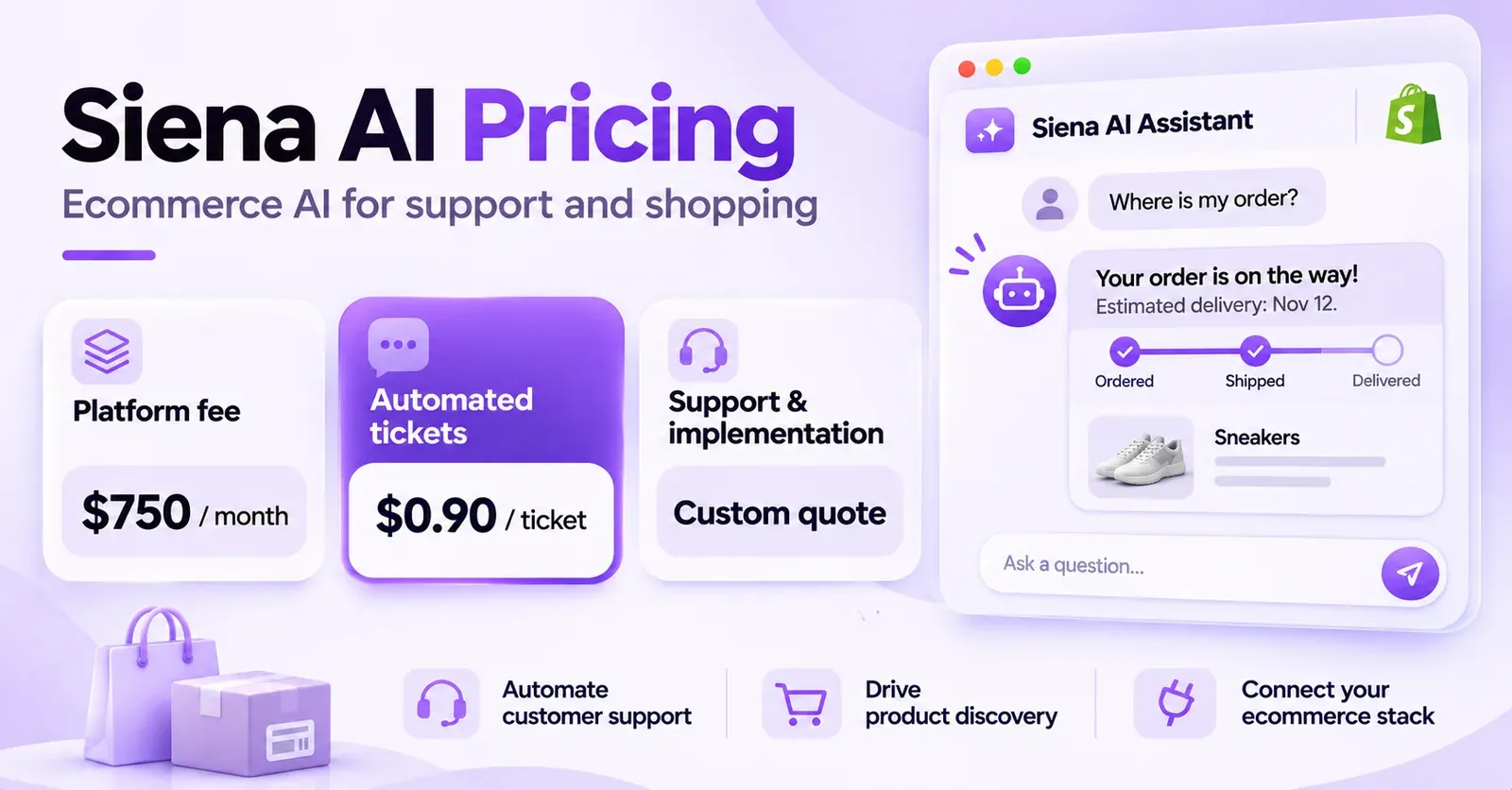
Siena AI pricing starts with a published $750 monthly platform fee, plus $0.90 per automated ticket. The platform fee covers access to Siena's core AI engine and an unlimited testing sandbox. Its pricing page also lists Support & Implementation, including expert onboarding and dedicated Slack support, but does not publish a separate standard price for that component. Siena asks businesses to request a tailored quote rather than offering a conventional self-service Starter, Growth, and Pro price table.
That makes the real cost dependent on how many tickets your company automates, exactly what Siena counts as an automated ticket, and the terms written into your order form. For example, 1,000 automated tickets would produce an illustrative $1,650 monthly subtotal using the publicly advertised amounts: $750 plus 1,000 × $0.90. The final invoice may differ because of agreed automation packages, usage thresholds, implementation scope, and additional services.
The most important caution is that an automated ticket is not necessarily a fully resolved support ticket. Siena's website uses both automated-ticket and per-conversation terminology, without publishing a complete technical definition of every billable edge case. It would therefore be inaccurate to treat its $0.90 figure as identical to a competitor's fee for a ticket resolved end to end without human intervention.
This guide explains Siena AI's public pricing, example monthly budgets, the impact of its fixed platform charge, overage rules, free trials, contract terms, ecommerce integrations, and what to verify when buying the Shopping Agent. All prices are in US dollars, based on public vendor materials reviewed in November 2026. Calculations exclude taxes and outside software fees unless indicated.
Siena AI pricing at a glance
| Pricing component | Published price | What the vendor describes |
|---|---|---|
| Platform fee | $750 per month | Core AI engine and unlimited sandbox |
| Automation Pack | $0.90 per automated ticket | Variable charge or reference rate tied to automation volume |
| Support & Implementation | Price not separately published | Expert onboarding and dedicated Slack support |
| Customized offer | Quote required | Agreed ticket volume, products, services, and contract conditions |
| Permanent free plan | None publicly listed | No ongoing $0 tier shown on the pricing page |
| Free trial | May be offered | Eligibility and duration defined in the order form |
| Annual discount | No universal rate published | Contract duration and payment terms negotiated |
This is a pricing structure, not three plan tiers. Platform fee, Automation Pack, and Support & Implementation describe different components of a proposal. They should not be renamed Starter, Pro, and Enterprise, nor interpreted as three standalone subscriptions that a merchant can buy separately at the displayed prices.
Siena does not publish a standard minimum automation volume, a universal quantity included with the $750 platform charge, or a complete price schedule for its various specialized agents. The order form controls the final commercial arrangement. That qualification applies throughout this article.
 Quentin Olaya
What is Siena AI?
Siena AI is an artificial-intelligence customer-experience platform aimed at ecommerce brands. It operates as an intelligence and automation layer across support conversations, product discovery, social interactions, and customer insights. Merchants can connect it to Shopify and to existing customer-service software rather than automatically replacing every tool they already use.
For post-purchase support, Siena can use connected order data to answer shipment questions, check order status, and handle configured workflows involving cancellations, returns, address changes, replacements, and refunds. Those are capabilities, not guarantees that every action will be available or automatically approved for every merchant. The business still needs appropriate permissions, policies, and escalation rules.
The platform also markets a Shopping Agent for pre-purchase assistance. It can help shoppers compare products, ask questions about materials or fit, receive recommendations, and navigate toward an add-to-cart action. Other modules include social interactions, reviews, quality assurance, and analysis of customer feedback. Whether a particular agent is included in an individual quote cannot be established from the public price figures alone.
Siena is positioned for brands that need more than a basic rule-based FAQ widget. It may be relevant when a company already uses a mature support stack and wants to automate repeatable workflows without losing the context carried by existing tickets and order records.
How much is the Siena AI platform fee?
The published base charge is $750 per month
Siena's pricing page lists $750 per month for access to its core AI engine and unlimited sandbox. The fixed amount is important because it does not disappear when relatively few tickets are automated.
A business automating 100 tickets in a month would not have a $90 software subtotal under the published structure. The illustrative charge is $750 + $90 = $840, before the effect of any other agreed package or services. Conversely, 5,000 automated tickets produce a calculated $5,250 subtotal, in which the platform fee is much smaller relative to total usage.
The $750 figure is a public reference price, not a contractual guarantee that every business can sign up without a sales conversation or obtain the exact same terms. Siena's quote form requests information about the brand and its average monthly ticket volume before a commercial proposal is prepared.
What does the unlimited sandbox mean?
The advertised platform fee includes an unlimited sandbox, which is intended for testing AI behavior before deployment. Teams can assess how the assistant handles questions, apply knowledge sources, evaluate instructions, and work on automation flows without necessarily exposing experiments to real customers.
An unlimited sandbox is not the same as a permanent free subscription or unlimited live production tickets. Nor does it prove that every possible testing scenario, data transfer, or advanced integration has no contractual limits. Merchants should confirm the scope of the test environment and whether sandbox interactions are excluded from paid production usage.
Is the $750 charge the whole subscription?
No. The official page explicitly adds a separate Automation Pack, priced at $0.90 per automated ticket. It also presents onboarding and dedicated Slack support as an element of the proposal. Siena does not disclose a universal fixed price for every support or implementation arrangement.
This does not prove an extra onboarding charge is mandatory. It simply means the full commercial treatment of implementation and support is not specified by a single public number. Ask for a line-item breakdown rather than assuming either that all support is free forever or that a particular setup fee must apply.
How does the $0.90 automated-ticket charge work?
An automated ticket is the published billing unit
Siena promotes the Automation Pack at $0.90 per automated ticket. The natural commercial implication is that usage costs increase with the number of qualifying tickets automated. But the pricing summary does not comprehensively define the point at which a ticket becomes billable.
In another official comparison, Siena describes its commercial model as per-conversation pricing rather than the kind of outcome-based pricing that depends on whether a customer issue is classified as fully resolved. These public descriptions should not be silently combined into an invented technical rule.
For example, imagine that an AI assistant recognizes a customer's order, identifies a possible delivery problem, drafts an explanation, and then transfers the case to a human agent for a final decision. Part of the ticket was automated, but the issue was not fully resolved by the AI alone. The public pricing material does not conclusively establish whether such a ticket counts toward the Automation Pack.
An automated ticket is not an individual AI message
One customer ticket may involve several messages, knowledge lookups, order checks, and workflow steps. The pricing page does not say that each outgoing sentence or AI reply automatically creates a separate $0.90 charge. Conversely, it does not guarantee that every series of messages across channels will always be grouped into one billing unit.
A support conversation, a ticket, a customer interaction, an AI reply, and a full resolution are not interchangeable. Businesses migrating from another automation provider should check which events drive the invoice before comparing nominal unit prices.
| Event | Public billing status |
|---|---|
| Customer ticket automated within Siena's contracted scope | Reference unit shown at $0.90 |
| Ticket completely resolved without human involvement | A relevant use case, but not the only definition conclusively established |
| AI-assisted ticket later handled by a human | Counting rule not fully published |
| Ticket classified or routed by AI | Counting rule not fully published |
| Several AI replies inside the same support case | Exact grouping rule not fully published |
| Ticket reopened after closure | Rebilling policy not publicly defined |
| Sandbox test of an automation | Sandbox is advertised as unlimited; exact exclusions should be confirmed |
| Pre-purchase product recommendation with no traditional support ticket | Shopping Agent billing scope needs confirmation |
Questions every buyer should ask
Ask Siena to define the billable event in the order form or an attached usage specification. Request examples of a fully autonomous resolution, a human handoff, an abandoned conversation, a reopened case, a proactive shopping prompt, and a test interaction. Ask how one customer's activity across email, chat, SMS, and social channels is consolidated.
These definitions can change the effective cost more than a small discount on the $0.90 reference rate. A provider that charges for every AI-handled conversation cannot be compared directly to one that bills only when the AI closes a ticket without human intervention.
Siena AI monthly cost examples
For a simple illustration, the arithmetic is:
Illustrative monthly subtotal = $750 platform fee + ($0.90 × automated tickets).
This formula assumes all counted tickets are priced at the public reference rate, with no negotiated discounts, usage minimums, other support fees, or custom terms. The resulting amounts are not binding vendor quotes.
| Automated tickets per month | Platform fee | Automation component | Illustrative monthly subtotal |
|---|---|---|---|
| 0 | $750 | $0 | $750 |
| 100 | $750 | $90 | $840 |
| 250 | $750 | $225 | $975 |
| 500 | $750 | $450 | $1,200 |
| 1,000 | $750 | $900 | $1,650 |
| 2,000 | $750 | $1,800 | $2,550 |
| 3,000 | $750 | $2,700 | $3,450 |
| 5,000 | $750 | $4,500 | $5,250 |
| 10,000 | $750 | $9,000 | $9,750 |
Example 1: a small support operation
Suppose a Shopify shop has 100 qualifying automated tickets per month. The published components produce a subtotal of $840, equivalent to $8.40 for each automated ticket after distributing the fixed charge. That is materially different from the advertised $0.90 variable rate.
If the company has only occasional support demand, the fixed platform expense can dominate its economics. A low volume does not necessarily mean Siena is unsuitable; specialized integrations or revenue-related uses may offer value. But a merchant should not choose Siena solely by seeing a sub-dollar ticket rate.
Example 2: a growing ecommerce brand
At 1,000 qualifying automated tickets per month, the simplified subtotal becomes $1,650. The average effective cost is $1.65 for each automated ticket, including the platform fee. At this volume the fixed portion is significant, but less dominant than in the 100-ticket example.
The merchant should separately assess any support software subscriptions it still pays, the complexity of its knowledge sources, and the actual number of tickets that become billable. A monthly estimate based on all inbound tickets would be misleading if only some of them qualify as automated.
Example 3: a higher-volume brand
At 5,000 qualifying automated tickets, the public pricing formula produces $5,250 per month. Dividing that subtotal by 5,000 gives an effective $1.05 per automated ticket, assuming no other charges. The platform fee represents about 14.3% of this amount, compared with roughly 89.3% at 100 tickets.
At high volume, negotiated commercial terms may become especially important. The public website asks businesses to obtain a quote, so a company should not assume all 5,000 interactions will necessarily be billed at exactly $0.90 without regard to a contracted package.
Why the effective cost per ticket is higher than $0.90
Siena's variable price describes only one component of total spending. When the fixed platform fee is spread over the number of actual billable tickets, the average effective cost declines as usage grows.
| Automated tickets per month | Illustrative subtotal | Effective cost per automated ticket |
|---|---|---|
| 100 | $840 | $8.40 |
| 250 | $975 | $3.90 |
| 500 | $1,200 | $2.40 |
| 1,000 | $1,650 | $1.65 |
| 2,000 | $2,550 | $1.275 |
| 3,000 | $3,450 | $1.15 |
| 5,000 | $5,250 | $1.05 |
| 10,000 | $9,750 | $0.975 |
This calculation is often more useful for budgeting than looking at the variable price in isolation. It also exposes why the same software can have very different economics for a small merchant and a major direct-to-consumer brand.
An effective cost per ticket is a mathematical ratio, not a separately advertised unit price. If the contract contains minimum commitments, prepaid packages, discount tiers, or unused capacity, actual economics can be different.
Should you count all incoming support tickets?
Not automatically. Stores may receive thousands of support contacts each month, but only a subset will be suitable for automation. Among eligible contacts, another subset may be classified as automated under the vendor's billing rules.
Suppose a store receives 3,000 tickets a month, and 50% qualify as automated under its agreed definition. That produces 1,500 billable tickets in a model based on automated volume. Applying the public reference amounts would give $750 + 1,500 × $0.90 = $2,100. If only 20% qualify, the subtotal would instead be $1,290.
| Monthly incoming tickets | Hypothetical automated share | Automated-ticket count | Illustrative monthly subtotal |
|---|---|---|---|
| 1,000 | 30% | 300 | $1,020 |
| 1,000 | 60% | 600 | $1,290 |
| 3,000 | 50% | 1,500 | $2,100 |
| 5,000 | 60% | 3,000 | $3,450 |
| 10,000 | 70% | 7,000 | $7,050 |
| 20,000 | 80% | 16,000 | $15,150 |
These automation shares are hypothetical, not predictions or Siena performance guarantees. The table is useful only if the agreed billable-ticket definition matches the assumed count. For a reliable forecast, work from real support history or a representative trial rather than general industry benchmarks.
 Quentin Olaya
Does Siena AI have overage fees?
Yes, the contract allows charges beyond the agreed volume
Siena's Terms of Service state that usage exceeding the contracted scope may generate overage fees calculated according to the order form. Those charges are billed after the additional usage. The terms also say Siena will notify customers when consumption approaches or exceeds their purchased volume.
Continued use after such a notification is treated by the terms as acceptance of the applicable overage charges. This is a meaningful financial consideration for an operation experiencing seasonal peaks or rapid ticket growth.
Is every overage priced at $0.90?
No universal overage price is published. The $0.90 figure is the public Automation Pack reference, while the terms expressly defer contractual overage calculations to the order form. The negotiated marginal rate, volume tiers, or package terms may differ.
It is equally unsafe to promise that Siena automatically turns off its agents at the exact purchased threshold. The public terms describe notification and additional billing, not an unconditional hard stop for every account.
How to control unexpected usage charges
Before signing, ask for a written monthly or annual commitment, the precise usage counter, the extra-unit price, any grace allowance, and how warnings will be delivered. If your finance team needs a hard spending ceiling, request an explicit contractual cap or stop rule rather than assuming a toggle exists in every workspace.
The same consideration applies to a promotional event. An automated agent that becomes extremely active during a product launch can be beneficial, but an uncertain billable unit makes forecasting harder. Set a process for monitoring volume and reviewing outliers before they become a billing dispute.
Is Siena AI billed monthly or annually?
The pricing page quotes its platform fee as $750 per month, but it does not publish a universal annual package or discount percentage. The Terms of Service make the subscription's actual duration, payment schedule, scope, and price dependent on the accepted order form.
There is no established public rule that every customer receives a month-to-month contract cancelable without further financial obligation. Nor is there proof that every customer must sign a twelve-month term. Both claims would exceed the available documentation.
What happens to unused automation packages?
The terms generally say unused features, packages, and services expire at the end of the subscription term unless the agreement says otherwise. However, they also provide a rollover arrangement for unused automated features from one year to the next under multi-year agreements, subject to the applicable order form.
That means neither blanket claim is accurate: unused credits do not universally roll over, and they do not necessarily expire in every multiyear arrangement. The policy that matters is the one attached to the particular proposal.
Can Siena change the price after signup?
The terms allow changes at renewal or during a mutually agreed negotiation period, while stating that changes do not affect an existing subscription term without the relevant agreement. The quoted $750 fee and $0.90 reference rate should therefore be treated as published current pricing, not a lifetime price guarantee.
Is Siena AI free? What about a free trial?
Siena's pricing page does not list a permanent free plan. It asks visitors to provide information and obtain tailored pricing. The unlimited sandbox referenced in the $750 platform fee is a testing entitlement associated with the commercial platform, not evidence of a free-forever production subscription.
The Terms of Service do allow Siena to offer a free trial, but they leave the duration and transition conditions to the individual order form. There is no universal seven-, fourteen-, or thirty-day trial publicly promised in the current pricing information reviewed here.
A merchant should therefore ask whether a trial is available, whether it covers real production interactions or only a demonstration, how usage is counted during the evaluation, and precisely when paid obligations begin. The company's ability to arrange a trial does not automatically create a standardized self-service offer.
A demo can still be a valuable first step, especially if a merchant can provide representative support scenarios, a difficult set of product questions, and examples of actions it wants the agent to perform under actual store policies.
Is implementation or dedicated support included?
The public pricing presentation has a distinct Support & Implementation section describing expert onboarding and dedicated Slack support. Siena also emphasizes that successful automation involves connecting systems, preparing a knowledge base, designing workflows, and testing customer-facing behavior before launch.
However, the page does not show a universal separate setup fee or state precisely how much customized development is included. It would be misleading to invent a $500, $1,500, or $5,000 mandatory charge. It would be equally misleading to promise unlimited implementation hours or free custom integration work on every contract.
For procurement, ask the vendor to distinguish standard onboarding, ongoing operational support, additional workflow development, bespoke integrations, and post-launch optimization. Request ownership of each activity, any included hours, support availability, and the scope of the dedicated Slack channel.
Which Siena AI features are available?
Siena markets a wider family of specialized agents and insights products, not only a support-chat widget. Its public pricing structure does not specify which of these are necessarily enabled on every commercial subscription.
| Product or capability | Advertised use | What to verify commercially |
|---|---|---|
| Customer Service Agent | Automates support requests and order-related workflows | Covered channels, automated-ticket counting, actions |
| Shopping Agent | Pre-purchase advice, product discovery, recommendations | Inclusion and billing of non-support conversations |
| Social Agent | Social-media questions, messages, and comments | Covered networks, limits, cost per interaction |
| Reviews Agent | Review moderation and responses | Whether separate usage or license terms apply |
| QA Agent | Conversation quality evaluation | Included analytics and any processing limits |
| Ask Siena | Insights drawn from customer and operational data | Access rights and data scope |
| Topics Explorer | Customer feedback and recurring themes | Entitlement and refresh cadence |
| Copilot or human-assist capabilities | Helps support employees complete work | Seat and action limits, if any |
A product's presence on Siena's website demonstrates that the company markets the capability. It does not establish that every product is covered by the $750 platform charge or that every action qualifies as a $0.90 ticket. The purchased modules must be named in the order form.
Does the Shopping Agent have the same $0.90 price?
The Shopping Agent focuses on the buying journey
Siena's Shopping Agent is designed to answer pre-purchase questions, recommend products, help shoppers evaluate alternatives, and support buying decisions. It can provide product links and add-to-cart actions in a conversational experience, using catalog and customer context.
For example, a shopper may ask for a suitable skincare product, compare two running shoes, or request a travel accessory within a specific budget. Those activities differ from resolving a support ticket about a delivered order. They may be commercially valuable even if no support case is ever opened.
The exact pricing scope is not public
The current page advertises $0.90 per automated ticket, but does not explain how a standalone product recommendation or proactive shopping interaction is classified for billing. That means it is not possible to state that every recommendation, add-to-cart action, or shopping message costs $0.90.
It is also not established that the Shopping Agent is automatically included at no additional cost for every company paying the platform fee. Merchants evaluating Siena primarily for conversion improvement should request a Shopping Agent-specific price and entitlement description rather than assume that support automation pricing covers all pre-purchase activity.
Does Siena charge a sales commission?
No standard commission percentage on attributed ecommerce revenue is identified in the published main pricing structure. That does not prove a custom Sales or Shopping Agent proposal could never contain negotiated terms, but a commission should not be invented. Ask how the vendor separates assistance costs, attributed revenue reports, and any fees tied to the activated product.
What ecommerce integrations does Siena AI support?
Siena advertises connections with Shopify and a range of common commerce, helpdesk, shipping, subscription, and marketing systems. Its integrations are a significant part of the proposition because the AI can use data and execute configured actions in the tools where teams already work.
| Category | Examples of published integrations |
|---|---|
| Ecommerce | Shopify |
| Customer support | Gorgias, Zendesk, Kustomer, Gladly, Dixa, Intercom |
| Subscriptions | Recharge, Skio, Smartrr, Stay AI, Ordergroove |
| Returns | Loop Returns |
| Marketing | Klaviyo |
| Reviews and loyalty | Yotpo, Okendo |
| Shipping and fulfillment | AfterShip, ShipBob, ShipMonk, Wonderment |
| Payments | Stripe |
| Internal collaboration | Slack |
| Knowledge and information | Google Docs, Google Sheets |
| Custom workflows | API and configured actions, subject to scope |
Shopify order actions
Siena describes an integration able to look up order history, update customer details, change an eligible shipping address, process returns or replacements, and execute refund-related workflows. These capabilities require proper access and merchant-defined policies. They do not mean an assistant should be permitted to issue every refund without safeguards.
Does Siena replace an existing helpdesk?
Siena can operate alongside services such as Gorgias or Zendesk. This may preserve the team's established workflows and reduce the need for an immediate helpdesk migration. But it also means the existing helpdesk subscription may remain a separate expense.
A merchant paying Siena to automate support and Gorgias to provide the inbox should model both costs. Likewise, an integration with Klaviyo does not include Klaviyo's email or SMS fees; external messaging is governed by that provider's commercial terms.
 Quentin Olaya
Are every integration and channel included?
Not necessarily. Compatibility is different from a guarantee of a no-cost connector and unlimited usage. Businesses should ask for the exact list of enabled integrations and channels, and whether bespoke work or external delivery charges are required. Messaging through SMS, social media, or email can introduce costs outside the Siena software fee.
Does Siena AI charge per human support seat?
The public pricing page does not list a separate standard price for each human support agent seat. It also does not establish a universal, contractual promise of unlimited seats for every subscription.
Those are different statements. The absence of a published price cannot be turned into either a positive claim that seats are always free or a fabricated $19-per-agent charge. Ask how staff access, roles, permissions, and any workspace limits are treated in the order form.
If Siena operates over another helpdesk, the third-party provider may continue charging per seat or under its own usage model. Those outside charges should be included in a total-cost comparison even when Siena itself is not quoting a line item for every employee.
What are Siena AI's cancellation and refund rules?
Fees are generally nonrefundable
Siena's Terms of Service state that fees are not refundable under the general payment provision. The contract also includes particular exceptions, such as certain intellectual-property circumstances in which affected services cannot continue and unused prepaid fees for that portion may be returned. These exceptions are not a universal satisfaction or money-back guarantee.
The subscription term comes from the order form
The agreement remains active for the period specified in the accepted order form. Deleting an account or turning off a widget should not be treated as proof that an existing financial commitment has ended without further obligations.
No universal right to cancel any annual contract immediately and receive a prorated cash refund is established by the public conditions. Verify the renewal procedure, termination rights, required notice, and any minimum commitment before agreeing to a paid deployment.
What happens to business data after cancellation?
The terms describe retention of user content for up to 90 days following expiration or termination, with provisions for transferring that content on request and a requirement to provide timely notice. More specifically, a client must notify Siena of its transfer request within seven days after the agreement ends under the published provisions.
Businesses migrating their support workflows should plan exports well before the contract ends, including their knowledge base, conversation history, custom actions, and any operational records they are entitled to receive. The exact scope and method of export should be confirmed with the provider.
How should merchants calculate Siena AI's return on investment?
A practical ROI model should separate three things: software spending, work actually avoided, and incremental commercial value. Siena's published $750 platform fee and automated-ticket rate provide a starting point for the first component. The other two depend on the merchant's operations and measured outcomes.
Suppose a merchant has 2,000 tickets that qualify as automated under its contract. The simplified Siena subtotal is $2,550. If each automated ticket genuinely saves $2 of avoidable human or operating expense, the theoretical saving is $4,000 before software charges and other effects. That could leave $1,450 in benefit before any separate implementation, helpdesk, or management expenses.
But this arithmetic is illustrative, not a vendor performance guarantee. Some employee time may be reallocated rather than eliminated. Some tickets may still require review, and not every automated contact displaces an equivalent amount of paid human work.
Automation rate is not the same as full resolution rate
When interpreting marketing results, ask whether a reported percentage refers to conversations the AI handled, tickets fully resolved without a person, or interactions on which the AI performed at least one action. The distinction affects both the operational value and the billing counter.
Siena publishes customer testimonials involving high automation rates, strong satisfaction scores, and faster handling. Those are results reported for particular implementations, not promises that all merchants will achieve the same numbers. The company's marketing also highlights product recommendations and assisted sales, but an order attributed to the AI is not necessarily an incremental order caused by the AI.
A more useful break-even exercise
Estimate the monthly number of contract-defined automated tickets, the avoidable cost per human-managed ticket, any extra cost of quality control, the value of better service, and the fees of other systems still required. Then test those assumptions against live data rather than relying on a generic case study.
If the expected benefits are highly uncertain, the unlimited sandbox and potential trial arrangements can help test quality and suitability. However, the public terms do not guarantee a specific trial duration or define a universally available financial refund if ROI falls short.
How to choose whether Siena AI is right for your store
Step 1: measure your real support workload
Collect your monthly tickets by channel and category. Separate simple order-status inquiries from complex exceptions, policy decisions, and low-quality or spam contacts. This gives a better foundation than projecting solely from website visitors.
Step 2: identify what must be automated
List the workflows that genuinely save staff time or improve the customer journey: tracking, cancellations, returns, subscriptions, product comparisons, or after-hours questions. For every action with financial consequences, define permissions and escalation paths.
Step 3: get the billable-ticket definition in writing
Confirm whether tickets that receive a partial AI answer, are escalated to staff, are reopened later, or appear across multiple channels generate charges. Ask how sandbox activity is excluded and how the billing report can be audited.
Step 4: model the fixed fee and usage together
A $0.90 unit rate is not the full effective cost. Add the $750 monthly platform fee and whatever charges the order form places on support, integrations, or other agents. Run low-, normal-, and peak-volume scenarios.
Step 5: confirm the Shopping Agent and integration scope
If product discovery is your priority, make sure the Shopping Agent's entitlements and pricing are explicitly stated. Verify integration availability, data synchronization, and costs from Gorgias, Zendesk, Klaviyo, or other connected software.
Step 6: review the commercial agreement before launch
Obtain clarity on contract length, unused capacity, rollover, overage rates, warning thresholds, termination, refunds, and data export. If avoiding unplanned charges is essential, request contractual spending protections rather than assuming a universal automatic cap.
Frequently asked questions about Siena AI pricing
How much does Siena AI cost per month?
Siena publishes $750 per month for platform access plus $0.90 per automated ticket. Support and implementation are also part of its commercial offer, but no universal separate price is displayed. Actual terms are provided by quote.
Does Siena AI have a free plan?
No permanent free tier appears in the current public pricing page. The company advertises an unlimited sandbox within its platform fee and its terms permit trials agreed in an order form.
Is Siena AI $0.90 per conversation?
The pricing page says $0.90 per automated ticket, while another official comparison describes a per-conversation model. The exact billable event needs confirmation. It should not be assumed to mean one AI message or one fully resolved ticket.
Is there a $750 minimum monthly cost?
The published platform fee is $750 per month before the variable Automation Pack. The final contract may define other fees, minimums, or conditions. The $750 figure is the advertised fixed component rather than an all-inclusive quote.
How much would 1,000 automated tickets cost?
Under the basic public calculation, $750 + 1,000 × $0.90 = $1,650 per month, before taxes and any other services. The actual amount depends on the agreed billing unit and order form.
How much would 5,000 automated tickets cost?
The illustrative subtotal is $5,250 per month, comprising $750 fixed plus $4,500 of automated-ticket usage. The effective average is $1.05 per counted ticket, assuming the public rate and no other charges.
Does Siena charge only for fully resolved tickets?
That condition is not conclusively established by Siena's public pricing description. The vendor uses automated-ticket and per-conversation terminology. Buyers should confirm whether partial automation and human escalations are chargeable.
Are overages always billed at $0.90?
No universal overage rate is established. Siena's terms say excess usage is billed under the conditions of the accepted order form, with notification when consumption approaches or exceeds a purchased amount.
Can Siena automatically block spending at a quota?
The public terms do not guarantee a standard hard cap on every account. Merchants needing one should negotiate it and confirm the operational behavior if usage reaches the limit.
Does Siena offer a 14-day trial?
No universal 14-day duration is published. The terms permit free trials but make their duration and transition to paid service subject to the order form.
Is Siena AI billed annually?
The website presents a monthly platform reference price. The contract term and payment schedule are agreed in the order form. No standard public annual discount percentage is established.
Do unused Siena credits roll over?
Unused packages generally expire at the end of the subscription term unless otherwise agreed. The terms also provide for eligible rollover between years on multiyear agreements, subject to the order form.
Is Siena Shopping Agent included in the platform fee?
The public page does not specify a universal entitlement for every specialized agent. Merchants should verify Shopping Agent access and the billing of pre-purchase conversations in their individual quote.
Does Siena replace Gorgias or Zendesk?
Siena can work with existing helpdesks including Gorgias, Zendesk, and others. Those third-party subscriptions may remain payable separately even when Siena automates a portion of the work.
Are Siena human agent seats unlimited?
The public main pricing page does not list a standard per-seat charge, but it does not offer an unconditional unlimited-seat promise. Check seat and workspace rights in the contract.
Does Siena charge a setup fee?
Siena lists expert onboarding and dedicated Slack support, but does not publish one mandatory setup price for every buyer. Ask whether custom integration or additional implementation work involves separate fees.
Can I cancel Siena AI and get a refund?
The terms generally make fees nonrefundable and tie subscription duration to the accepted order form, subject to specified exceptions. A universal cancel-anytime prorated refund is not established.
Does Siena AI guarantee 80% automation?
No universal guaranteed automation level is established by the public pricing. The company reports strong results from selected customers, but actual outcomes depend on ticket mix, integrations, policies, and deployment quality.